Test Statistics In Exercises 9–12, refer to the exercise identified and find the value of the test statistic. (Refer to Table 8-2 to select the correct expression for evaluating the test statistic.)
Exercise 5 “Landline Phones”
Verified step by step guidance
1
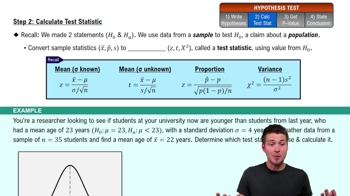
Identify the type of hypothesis test being conducted (e.g., z-test, t-test, chi-square test, etc.) based on the context of the problem and the data provided in Exercise 5 'Landline Phones'. Refer to Table 8-2 for guidance on the appropriate test statistic formula.
Determine the null hypothesis (H₀) and the alternative hypothesis (H₁) for the problem. Clearly state what is being tested (e.g., population mean, proportion, variance, etc.).
Collect the necessary data from the problem, such as the sample size (n), sample mean (x̄), population mean (μ), standard deviation (σ or s), or proportions (p̂ and p).
Substitute the collected values into the appropriate test statistic formula. For example, if it is a z-test for a population mean, use the formula: . If it is a t-test, use the t-test formula instead.
Simplify the expression to calculate the test statistic value. Ensure all calculations are performed correctly, but do not compute the final numerical value here.
Verified video answer for a similar problem:
This video solution was recommended by our tutors as helpful for the problem above
Video duration:
1m
Play a video:
0 Comments
Key Concepts
Here are the essential concepts you must grasp in order to answer the question correctly.
Test Statistic
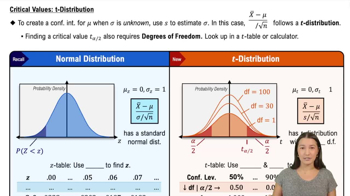
A test statistic is a standardized value that is calculated from sample data during a hypothesis test. It measures the degree to which the sample data deviates from the null hypothesis, allowing researchers to determine whether to reject or fail to reject the null hypothesis. Common test statistics include the t-statistic and z-statistic, which are used depending on the sample size and whether the population standard deviation is known.
Hypothesis testing is a statistical method used to make decisions about a population based on sample data. It involves formulating a null hypothesis (H0) and an alternative hypothesis (H1), then using a test statistic to evaluate the evidence against the null hypothesis. The outcome determines whether there is sufficient evidence to support the alternative hypothesis, typically assessed using a significance level (alpha).
A critical value is a threshold that determines the boundary for rejecting the null hypothesis in hypothesis testing. It is derived from the chosen significance level and the distribution of the test statistic. If the calculated test statistic exceeds the critical value, the null hypothesis is rejected, indicating that the sample provides enough evidence to support the alternative hypothesis.