Quality ControlSuppose the mean wait-time for a telephone reservation agent at a large airline is 43 seconds. A manager with the airline is concerned that business may be lost due to customers having to wait too long for an agent. To address this concern, the manager develops new airline reservation policies that are intended to reduce the amount of time an agent needs to spend with each customer. A random sample of 250 customers results in a sample mean wait-time of 42.3 seconds with a standard deviation of 4.2 seconds. Using an α = 0.05 level of significance, do you believe the new policies were effective? Do you think the results have any practical significance?
Table of contents
- 1. Intro to Stats and Collecting Data1h 14m
- 2. Describing Data with Tables and Graphs1h 56m
- 3. Describing Data Numerically2h 5m
- 4. Probability2h 17m
- 5. Binomial Distribution & Discrete Random Variables3h 6m
- 6. Normal Distribution and Continuous Random Variables2h 11m
- 7. Sampling Distributions & Confidence Intervals: Mean3h 23m
- Sampling Distribution of the Sample Mean and Central Limit Theorem19m
- Distribution of Sample Mean - ExcelBonus23m
- Introduction to Confidence Intervals15m
- Confidence Intervals for Population Mean1h 18m
- Determining the Minimum Sample Size Required12m
- Finding Probabilities and T Critical Values - ExcelBonus28m
- Confidence Intervals for Population Means - ExcelBonus25m
- 8. Sampling Distributions & Confidence Intervals: Proportion2h 10m
- 9. Hypothesis Testing for One Sample5h 8m
- Steps in Hypothesis Testing1h 6m
- Performing Hypothesis Tests: Means1h 4m
- Hypothesis Testing: Means - ExcelBonus42m
- Performing Hypothesis Tests: Proportions37m
- Hypothesis Testing: Proportions - ExcelBonus27m
- Performing Hypothesis Tests: Variance12m
- Critical Values and Rejection Regions28m
- Link Between Confidence Intervals and Hypothesis Testing12m
- Type I & Type II Errors16m
- 10. Hypothesis Testing for Two Samples5h 37m
- Two Proportions1h 13m
- Two Proportions Hypothesis Test - ExcelBonus28m
- Two Means - Unknown, Unequal Variance1h 3m
- Two Means - Unknown Variances Hypothesis Test - ExcelBonus12m
- Two Means - Unknown, Equal Variance15m
- Two Means - Unknown, Equal Variances Hypothesis Test - ExcelBonus9m
- Two Means - Known Variance12m
- Two Means - Sigma Known Hypothesis Test - ExcelBonus21m
- Two Means - Matched Pairs (Dependent Samples)42m
- Matched Pairs Hypothesis Test - ExcelBonus12m
- Two Variances and F Distribution29m
- Two Variances - Graphing CalculatorBonus16m
- 11. Correlation1h 24m
- 12. Regression3h 33m
- Linear Regression & Least Squares Method26m
- Residuals12m
- Coefficient of Determination12m
- Regression Line Equation and Coefficient of Determination - ExcelBonus8m
- Finding Residuals and Creating Residual Plots - ExcelBonus11m
- Inferences for Slope31m
- Enabling Data Analysis ToolpakBonus1m
- Regression Readout of the Data Analysis Toolpak - ExcelBonus21m
- Prediction Intervals13m
- Prediction Intervals - ExcelBonus19m
- Multiple Regression - ExcelBonus29m
- Quadratic Regression15m
- Quadratic Regression - ExcelBonus10m
- 13. Chi-Square Tests & Goodness of Fit2h 21m
- 14. ANOVA2h 29m
9. Hypothesis Testing for One Sample
Performing Hypothesis Tests: Means
Problem 10.T.2c
Textbook Question
The trade magazine QSR routinely examines fast-food drive-thru service times. Their recent research indicates that the mean time a car spends in a McDonald’s drive-thru is 167.1 seconds. A McDonald's manager in Salt Lake City feels that she has instituted a drive-thru policy that results in lower drive-thru service times. A random sample of 70 cars results in a mean service time of 163.9 seconds, with a standard deviation of 15.3 seconds. Determine whether the policy is effective in reducing drive-thru service times.
c. Conduct the appropriate test to determine if the policy is effective.
Verified step by step guidance1
Identify the null hypothesis (\(H_0\)) and the alternative hypothesis (\(H_a\)). Since the manager believes the policy reduces service times, set \(H_0: \mu = 167.1\) seconds (no change) and \(H_a: \mu < 167.1\) seconds (mean service time is less).
Determine the significance level (\(\alpha\)), commonly set at 0.05, which will be used to decide whether to reject the null hypothesis.
Calculate the test statistic using the formula for a one-sample t-test since the population standard deviation is unknown and the sample size is 70 (which is large, but we still use t-test):
\[
t = \frac{\bar{x} - \mu_0}{s / \sqrt{n}}
\]
where \(\bar{x} = 163.9\) is the sample mean, \(\mu_0 = 167.1\) is the hypothesized population mean, \(s = 15.3\) is the sample standard deviation, and \(n = 70\) is the sample size.
Find the critical t-value from the t-distribution table for a left-tailed test with \(df = n - 1 = 69\) degrees of freedom and the chosen significance level \(\alpha\).
Compare the calculated t-statistic to the critical t-value:
- If \(t\) is less than the critical value, reject the null hypothesis, indicating evidence that the policy reduces service times.
- Otherwise, do not reject the null hypothesis, indicating insufficient evidence to conclude the policy is effective.
Verified video answer for a similar problem:This video solution was recommended by our tutors as helpful for the problem above
Video duration:
4mPlay a video:
0 Comments
Key Concepts
Here are the essential concepts you must grasp in order to answer the question correctly.
Hypothesis Testing
Hypothesis testing is a statistical method used to decide whether there is enough evidence to reject a null hypothesis in favor of an alternative hypothesis. In this context, the null hypothesis states that the mean service time has not decreased, while the alternative suggests it has. The test evaluates sample data to make this decision with a certain confidence level.
Recommended video:
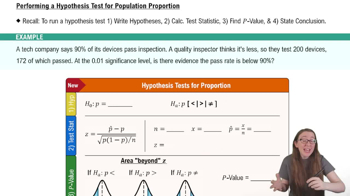
Performing Hypothesis Tests: Proportions
One-Sample t-Test
A one-sample t-test compares the sample mean to a known population mean when the population standard deviation is unknown. It uses the sample standard deviation and size to calculate a t-statistic, which helps determine if the observed difference is statistically significant. This test is appropriate here because the sample size is 70 and the population standard deviation is not given.
Recommended video:
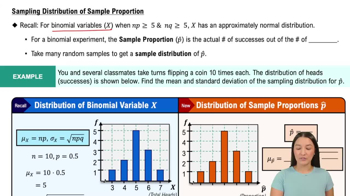
Sampling Distribution of Sample Proportion
Significance Level and p-Value
The significance level (commonly 0.05) is the threshold for deciding whether to reject the null hypothesis. The p-value measures the probability of observing the sample data, or something more extreme, if the null hypothesis is true. If the p-value is less than the significance level, the null hypothesis is rejected, indicating the policy likely reduces service times.
Recommended video:
Guided course
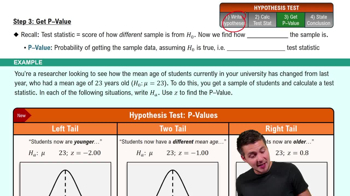
Step 3: Get P-Value
Related Videos
Related Practice
Textbook Question
35
views