Name each level of measurement for which data can be qualitative.
Verified step by step guidance
1
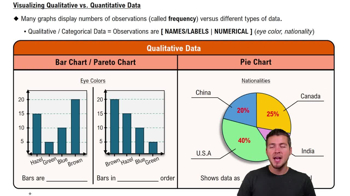
Understand the concept of qualitative data: Qualitative data refers to non-numeric information that describes categories or characteristics. Examples include colors, names, labels, or any data that cannot be measured numerically.
Review the four levels of measurement: Nominal, Ordinal, Interval, and Ratio. These levels classify data based on their properties and the types of operations that can be performed on them.
Identify which levels of measurement can be qualitative: Nominal and Ordinal levels are used for qualitative data. Nominal data represents categories without any order (e.g., gender, hair color), while Ordinal data represents categories with a meaningful order but without consistent intervals (e.g., rankings like 'poor', 'average', 'excellent').
Exclude Interval and Ratio levels: Interval and Ratio levels are used for quantitative data, which involves numeric values and measurable quantities. These levels are not applicable for qualitative data.
Summarize the answer: The levels of measurement for which data can be qualitative are Nominal and Ordinal.
Verified video answer for a similar problem:
This video solution was recommended by our tutors as helpful for the problem above
Video duration:
4m
Play a video:
0 Comments
Key Concepts
Here are the essential concepts you must grasp in order to answer the question correctly.
Levels of Measurement
Levels of measurement refer to the different ways in which data can be categorized and quantified. The four primary levels are nominal, ordinal, interval, and ratio. For qualitative data, the relevant levels are nominal and ordinal, which focus on categorizing data without a specific numerical value.
Difference in Proportions: Hypothesis Tests Example 1
Nominal Measurement
Nominal measurement is the simplest level of measurement, where data is categorized into distinct groups without any order or ranking. Examples include gender, race, or types of cuisine. In nominal data, the categories are mutually exclusive and collectively exhaustive, meaning each data point fits into one category only.
Ordinal measurement involves categorizing data into ordered groups, where the order matters but the differences between the ranks are not uniform. An example is a satisfaction survey with ratings like 'satisfied,' 'neutral,' and 'dissatisfied.' While we can rank these categories, we cannot quantify the exact difference between them.

 4:20 minutes
 Verified step by step guidance

 10:28
10:28