Putting It Together: Online Homework Keeping students engaged in the learning process greatly increases their chance of success in a course. Traditional lecture-based math instruction has given way to a more student-engaged approach where students interact with the teacher in class and receive immediate feedback to their responses. The teacher presence allows students, when incorrect in a response, to be guided through a solution and then immediately be given a similar problem to attempt. A researcher conducted a study to investigate whether an online homework system using an attempt—feedback— reattempt approach improved student learning over traditional pencil-and-paper homework. The online homework system was designed to increase student engagement outside class, something commonly missing in traditional pencil-and-paper assignments, ultimately leading to increased learning.The study was conducted using two first-semester calculus classes taught by the researcher in a single semester. One class was assigned traditional homework and the other was assigned online homework that used the attempt—feedback—reattempt approach. The summaries are based on data from the study.
f. What type of variable is letter grade? What level of measurement is letter grade? Do you think presenting the data in a table from A to F would be a better representation of the data than presenting it in a graph?
Verified step by step guidance
1
Identify the type of variable 'letter grade' represents. Letter grades (A, B, C, D, F) are categories that describe a student's performance level, so this variable is categorical.
Determine the level of measurement for the letter grade. Since letter grades have a meaningful order (A is better than B, B is better than C, etc.) but the differences between grades are not necessarily equal or measurable, the level of measurement is ordinal.
Explain why letter grades are ordinal: they indicate rank or order but do not quantify the exact difference between categories.
Consider how to best present the data. A table listing the frequency or count of each letter grade from A to F clearly shows the distribution and order of grades, making it easy to compare how many students earned each grade.
Compare this to a graph: while graphs (like bar charts) can visually display the distribution, a table might be more straightforward for ordinal data like letter grades, especially if the goal is to emphasize exact counts or frequencies rather than visual trends.
Verified video answer for a similar problem:
This video solution was recommended by our tutors as helpful for the problem above
Video duration:
3m
Play a video:
0 Comments
Key Concepts
Here are the essential concepts you must grasp in order to answer the question correctly.
Types of Variables
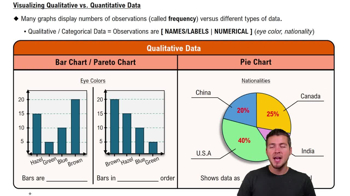
Variables in statistics can be classified as qualitative (categorical) or quantitative (numerical). Letter grades (A, B, C, etc.) are qualitative variables because they represent categories rather than numeric values. Understanding the type of variable helps determine appropriate methods for data analysis and visualization.
Levels of measurement describe how data values relate to each other and include nominal, ordinal, interval, and ratio. Letter grades are ordinal because they have a meaningful order (A is better than B), but the differences between grades are not necessarily equal. Recognizing the level of measurement guides the choice of statistical techniques.
Difference in Proportions: Hypothesis Tests Example 1
Data Presentation: Tables vs. Graphs
Choosing between tables and graphs depends on the data type and the message to convey. For ordinal categorical data like letter grades, tables listing frequencies or counts can clearly show distribution, while graphs (like bar charts) can visually highlight patterns. The decision depends on clarity, ease of interpretation, and the audience's needs.

 3:34 minutes
 Verified step by step guidance
 04:24
04:24