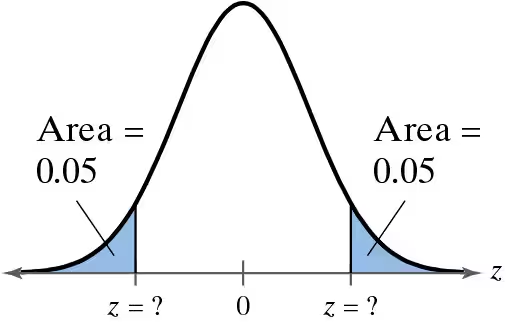
Graphical Analysis In Exercises 17–22, find the indicated z-score(s) shown in the graph.
Verified step by step guidance
1
Identify the problem: The graph shows a standard normal distribution (bell curve) with two shaded areas, each representing 0.05 of the total area under the curve. The task is to find the z-scores corresponding to these areas.
Understand the symmetry of the standard normal distribution: The curve is symmetric about z = 0. The two z-scores will be equidistant from the mean (z = 0), one negative and one positive.
Determine the cumulative area to the left of the positive z-score: Since the total area under the curve is 1, the cumulative area to the left of the positive z-score is 1 - 0.05 = 0.95.
Use a z-table or statistical software to find the z-score: Look up the cumulative area of 0.95 in the z-table to find the corresponding z-score. This will give the positive z-score. The negative z-score will be the same value but with a negative sign.
Verify the solution: Check that the cumulative area to the left of the negative z-score is 0.05 and the cumulative area to the left of the positive z-score is 0.95. This ensures the z-scores are correct.
Verified video answer for a similar problem:
This video solution was recommended by our tutors as helpful for the problem above
Video duration:
4m
Play a video:
0 Comments
Key Concepts
Here are the essential concepts you must grasp in order to answer the question correctly.
Z-Score
A z-score represents the number of standard deviations a data point is from the mean of a distribution. It is calculated by subtracting the mean from the data point and then dividing by the standard deviation. Z-scores are essential for understanding how far a value lies from the average, allowing for comparisons across different datasets.
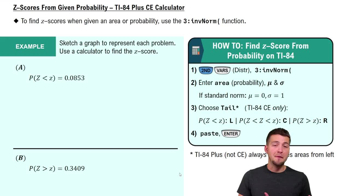
Z-Scores From Given Probability - TI-84 (CE) Calculator
Standard Normal Distribution
The standard normal distribution is a special case of the normal distribution where the mean is 0 and the standard deviation is 1. It is represented by a bell-shaped curve, and all z-scores correspond to specific areas under this curve. This distribution is crucial for calculating probabilities and z-scores in statistics.
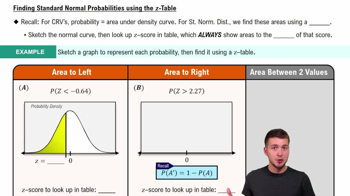
Finding Standard Normal Probabilities using z-Table
Area Under the Curve
In the context of the normal distribution, the area under the curve represents the probability of a value falling within a certain range. The total area under the curve equals 1, and specific areas correspond to probabilities associated with z-scores. Understanding how to interpret these areas is vital for finding z-scores related to given probabilities.