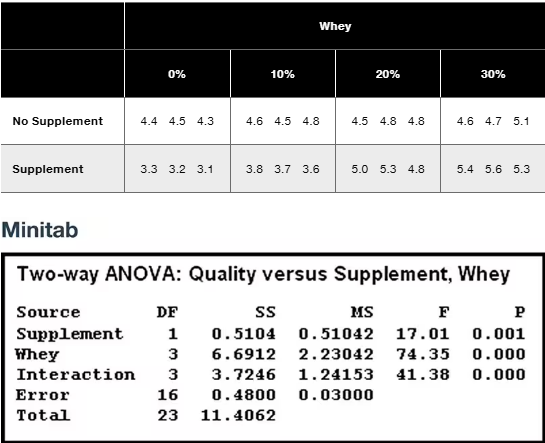
Pancake Experiment Listed below are ratings of pancakes made by experts (based on data from Minitab). Different pancakes were made with and without a supplement and with different amounts of whey. The results from two-way analysis of variance are shown. Use the displayed results and a 0.05 significance level. What do you conclude?
Verified step by step guidance
1
Step 1: Identify the factors and response variable. Here, the factors are 'Supplement' (with two levels: No Supplement and Supplement) and 'Whey' (with four levels: 0%, 10%, 20%, 30%). The response variable is the pancake quality rating.
Step 2: Examine the ANOVA table to understand the significance of each factor and their interaction. The table provides degrees of freedom (DF), sum of squares (SS), mean squares (MS), F-statistics (F), and p-values (P) for Supplement, Whey, and their Interaction.
Step 3: Use the significance level of 0.05 to interpret the p-values. If a p-value is less than 0.05, the corresponding factor or interaction is statistically significant, meaning it has a meaningful effect on pancake quality.
Step 4: Check the p-values for Supplement (0.001), Whey (0.000), and Interaction (0.000). Since all are less than 0.05, conclude that both main effects and their interaction significantly affect pancake quality.
Step 5: Understand the implication of a significant interaction effect: the effect of one factor depends on the level of the other factor. Therefore, analyze the interaction plot or means table to interpret how Supplement and Whey levels jointly influence pancake ratings.
Verified video answer for a similar problem:

This video solution was recommended by our tutors as helpful for the problem above
Video duration:
4m
Play a video:
0 Comments
Key Concepts
Here are the essential concepts you must grasp in order to answer the question correctly.
Two-Way ANOVA
Two-way ANOVA is a statistical method used to examine the effect of two independent factors on a dependent variable simultaneously. It tests for main effects of each factor and their interaction effect, helping to understand if factors independently or jointly influence the outcome.
The significance level (commonly 0.05) is the threshold for deciding if a result is statistically significant. A p-value less than this level indicates strong evidence against the null hypothesis, suggesting the factor or interaction has a meaningful effect on the response variable.
An interaction effect occurs when the effect of one factor depends on the level of another factor. In this experiment, a significant interaction means the impact of supplement on pancake quality changes depending on the whey percentage, indicating combined influence rather than independent effects.