"In Problems 5–8, determine whether the random variable is discrete or continuous. In each case, state the possible values of the random variable. a. The time it takes for a light bulb to burn out. b. The weight of a T-bone steak. c. The number of free-throw attempts before the first shot is made. d. In a random sample of 20 people, the number with type A blood."
Verified step by step guidance
1
Step 1: Understand the difference between discrete and continuous random variables. A discrete random variable takes on countable values (often integers), while a continuous random variable can take on any value within an interval or range.
Step 2: For part (a), consider the time it takes for a light bulb to burn out. Since time can be measured with infinite precision (e.g., seconds, milliseconds), this variable is continuous. The possible values are all positive real numbers representing time durations.
Step 3: For part (b), consider the weight of a T-bone steak. Weight can be measured with great precision and can take any value within a range, so this is a continuous random variable. The possible values are all positive real numbers representing weight.
Step 4: For part (c), consider the number of free-throw attempts before the first shot is made. This is a count of attempts, which can only be whole numbers (1, 2, 3, ...). Therefore, this is a discrete random variable. The possible values are positive integers starting from 1.
Step 5: For part (d), consider the number of people with type A blood in a sample of 20. This is a count of individuals, so it is discrete. The possible values are integers from 0 up to 20, inclusive.
Verified video answer for a similar problem:
This video solution was recommended by our tutors as helpful for the problem above
Video duration:
2m
Play a video:
0 Comments
Key Concepts
Here are the essential concepts you must grasp in order to answer the question correctly.
Discrete vs. Continuous Random Variables
A discrete random variable takes on countable values, often integers, such as counts or number of occurrences. A continuous random variable can take any value within an interval, representing measurements like time or weight. Identifying the type helps determine the appropriate probability models.
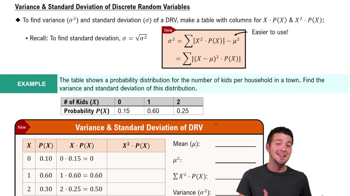
Variance & Standard Deviation of Discrete Random Variables
Possible Values of a Random Variable
The possible values of a random variable are the set of all outcomes it can assume. For discrete variables, this is a list or range of distinct values; for continuous variables, it is an interval or union of intervals. Clearly stating these values is essential for defining the variable's distribution.
Understanding the real-world context helps classify the variable correctly. For example, time until an event or weight is measured continuously, while counts like number of attempts or people with a trait are discrete. This interpretation guides the choice of statistical methods.