Interpreting P-value The Ericsson method is one of several methods claimed to increase the likelihood of a baby girl. In a clinical trial, results could be analyzed with a formal hypothesis test with the alternative hypothesis of p > 0.5 which corresponds to the claim that the method increases the likelihood of having a girl, so that the proportion of girls is greater than 0.5. If you have an interest in establishing the success of the method, which of the following P-values would you prefer as a result in your hypothesis test: 0.999, 0.5, 0.95, 0.05, 0.01, 0.001? Why?
Table of contents
- 1. Intro to Stats and Collecting Data1h 14m
- 2. Describing Data with Tables and Graphs1h 56m
- 3. Describing Data Numerically2h 5m
- 4. Probability2h 17m
- 5. Binomial Distribution & Discrete Random Variables3h 6m
- 6. Normal Distribution and Continuous Random Variables2h 11m
- 7. Sampling Distributions & Confidence Intervals: Mean3h 23m
- Sampling Distribution of the Sample Mean and Central Limit Theorem19m
- Distribution of Sample Mean - ExcelBonus23m
- Introduction to Confidence Intervals15m
- Confidence Intervals for Population Mean1h 18m
- Determining the Minimum Sample Size Required12m
- Finding Probabilities and T Critical Values - ExcelBonus28m
- Confidence Intervals for Population Means - ExcelBonus25m
- 8. Sampling Distributions & Confidence Intervals: Proportion2h 10m
- 9. Hypothesis Testing for One Sample5h 8m
- Steps in Hypothesis Testing1h 6m
- Performing Hypothesis Tests: Means1h 4m
- Hypothesis Testing: Means - ExcelBonus42m
- Performing Hypothesis Tests: Proportions37m
- Hypothesis Testing: Proportions - ExcelBonus27m
- Performing Hypothesis Tests: Variance12m
- Critical Values and Rejection Regions28m
- Link Between Confidence Intervals and Hypothesis Testing12m
- Type I & Type II Errors16m
- 10. Hypothesis Testing for Two Samples5h 37m
- Two Proportions1h 13m
- Two Proportions Hypothesis Test - ExcelBonus28m
- Two Means - Unknown, Unequal Variance1h 3m
- Two Means - Unknown Variances Hypothesis Test - ExcelBonus12m
- Two Means - Unknown, Equal Variance15m
- Two Means - Unknown, Equal Variances Hypothesis Test - ExcelBonus9m
- Two Means - Known Variance12m
- Two Means - Sigma Known Hypothesis Test - ExcelBonus21m
- Two Means - Matched Pairs (Dependent Samples)42m
- Matched Pairs Hypothesis Test - ExcelBonus12m
- Two Variances and F Distribution29m
- Two Variances - Graphing CalculatorBonus16m
- 11. Correlation1h 24m
- 12. Regression3h 33m
- Linear Regression & Least Squares Method26m
- Residuals12m
- Coefficient of Determination12m
- Regression Line Equation and Coefficient of Determination - ExcelBonus8m
- Finding Residuals and Creating Residual Plots - ExcelBonus11m
- Inferences for Slope31m
- Enabling Data Analysis ToolpakBonus1m
- Regression Readout of the Data Analysis Toolpak - ExcelBonus21m
- Prediction Intervals13m
- Prediction Intervals - ExcelBonus19m
- Multiple Regression - ExcelBonus29m
- Quadratic Regression15m
- Quadratic Regression - ExcelBonus10m
- 13. Chi-Square Tests & Goodness of Fit2h 21m
- 14. ANOVA2h 29m
9. Hypothesis Testing for One Sample
Steps in Hypothesis Testing
Problem 8.2.1a
Textbook Question
Statistical Literacy and Critical Thinking
In Exercises 1–4, use the results from a Hankook Tire Gauge Index survey of a simple random sample of 1020 adults. Among the 1020 respondents, 86% rated themselves as above average drivers. We want to test the claim that more than 3/4 of adults rate themselves as above average drivers.
Number and Proportions
a. Identify the actual number of respondents who rated themselves as above average drivers.
Verified step by step guidance1
Step 1: Understand the problem. We are tasked with identifying the actual number of respondents who rated themselves as above average drivers. The survey provides the total number of respondents (1020) and the percentage of those who rated themselves as above average drivers (86%).
Step 2: Convert the percentage into a decimal. To do this, divide the percentage (86%) by 100. This gives the proportion of respondents who rated themselves as above average drivers.
Step 3: Multiply the total number of respondents (1020) by the decimal proportion obtained in Step 2. This will give the actual number of respondents who rated themselves as above average drivers.
Step 4: Write the formula for clarity: Actual number = Total respondents × Proportion. Substitute the values: Actual number = 1020 × (86/100).
Step 5: Perform the multiplication to find the actual number of respondents. This will give the final result, which represents the number of adults who rated themselves as above average drivers.
Verified video answer for a similar problem:This video solution was recommended by our tutors as helpful for the problem above
Video duration:
1mPlay a video:
0 Comments
Key Concepts
Here are the essential concepts you must grasp in order to answer the question correctly.
Simple Random Sample
A simple random sample is a subset of individuals chosen from a larger population, where each individual has an equal chance of being selected. This method ensures that the sample is representative of the population, minimizing bias and allowing for valid statistical inferences. In this context, the sample of 1020 adults provides a basis for analyzing the self-assessment of driving skills among the general adult population.
Recommended video:
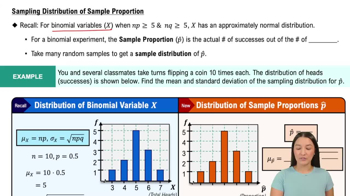
Sampling Distribution of Sample Proportion
Proportion
A proportion is a statistical measure that represents the part of a whole, expressed as a fraction or percentage. In this case, 86% of the respondents rated themselves as above average drivers, which can be converted into a proportion by dividing the number of respondents who rated themselves as such by the total number of respondents. Understanding proportions is essential for interpreting survey results and making comparisons.
Recommended video:
Guided course
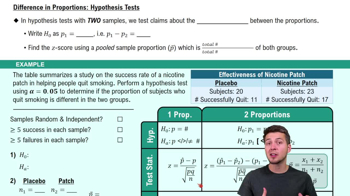
Difference in Proportions: Hypothesis Tests
Hypothesis Testing
Hypothesis testing is a statistical method used to determine whether there is enough evidence to support a specific claim about a population parameter. In this scenario, the claim is that more than 3/4 (or 75%) of adults consider themselves above average drivers. By conducting a hypothesis test, we can evaluate this claim using the sample data and assess whether the observed proportion significantly exceeds the hypothesized value.
Recommended video:
Guided course
Step 1: Write Hypotheses
Related Videos
Related Practice
Textbook Question
144
views