Roller Coaster z Score A larger sample of 92 roller coaster maximum speeds has a mean of 85.9 km/h and a standard deviation of 28.7 km/h. What is the z score for a speed of 34 km/h? Does the z score suggest that the speed of 34 km/h is significantly low?
Verified step by step guidance
1
Step 1: Recall the formula for calculating a z-score: , where is the observed value, is the mean, and is the standard deviation.
Step 2: Identify the given values from the problem: , , and .
Step 3: Substitute the given values into the z-score formula: .
Step 4: Simplify the numerator by subtracting the mean from the observed value: . Then divide the result by the standard deviation to compute the z-score.
Step 5: Interpret the z-score. If the z-score is less than -2, it suggests that the speed of 34 km/h is significantly low compared to the mean. Otherwise, it is not considered significantly low.
Verified video answer for a similar problem:
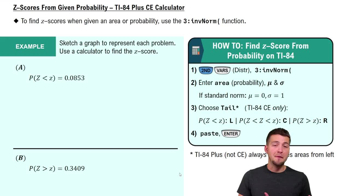
This video solution was recommended by our tutors as helpful for the problem above
Video duration:
3m
Play a video:
0 Comments
Key Concepts
Here are the essential concepts you must grasp in order to answer the question correctly.
Z Score
A z score, or standard score, indicates how many standard deviations an element is from the mean of a dataset. It is calculated using the formula: z = (X - μ) / σ, where X is the value in question, μ is the mean, and σ is the standard deviation. A z score can help determine the relative position of a value within a distribution, allowing for comparisons across different datasets.
Z-Scores From Given Probability - TI-84 (CE) Calculator
Mean and Standard Deviation
The mean is the average of a set of values, calculated by summing all values and dividing by the number of values. The standard deviation measures the amount of variation or dispersion in a set of values; a low standard deviation indicates that values tend to be close to the mean, while a high standard deviation indicates a wider spread. Together, these statistics provide a summary of the data's central tendency and variability.
In statistics, significance often refers to whether a result is likely due to chance or if it reflects a true effect. A z score can help assess significance by indicating how extreme a value is within a distribution. Typically, a z score beyond ±1.96 is considered significant at the 0.05 level, suggesting that the observed value is unlikely to occur under the null hypothesis, thus indicating a potential anomaly or noteworthy observation.