Kiosks Yolanda opened a new fast food restaurant. From her first customer, Yolanda kept track of the time a patron needed to wait from the time placing the order to the time the customer received his/her order. Because she was unhappy with the wait time, she invested in Kiosks to take orders with the goal of decreasing wait times. In a random sample of 20 customers, it was found the wait time was 52.3 seconds. e. Obtain 2000 simple random samples of size n=20 from the 10_3A_4 population data. Compute the mean wait time for each sample. That is, build a null model. What does each mean represent? Use the 2000 simple random samples to obtain a P-value for the hypothesis and judge whether the evidence suggests wait times have decreased. Provide an interpretation of the P-value and state a conclusion.
Verified step by step guidance
1
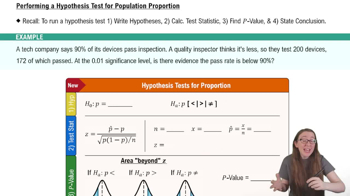
Step 1: Understand the context and hypothesis. Yolanda wants to test if the wait times have decreased after introducing kiosks. The null hypothesis (H0) is that the mean wait time has not decreased (i.e., the mean wait time is the same as before), and the alternative hypothesis (Ha) is that the mean wait time has decreased.
Step 2: Use the original population data (10_3A_4) to simulate the null model. This means you will repeatedly take 2000 simple random samples of size n = 20 from the population data, assuming the null hypothesis is true (no change in wait times).
Step 3: For each of the 2000 samples, calculate the sample mean wait time. Each mean represents a possible average wait time you could observe if the null hypothesis were true, reflecting natural sampling variability.
Step 4: Compare the observed sample mean wait time (52.3 seconds) to the distribution of the 2000 sample means generated under the null model. Calculate the P-value as the proportion of these sample means that are less than or equal to 52.3 seconds (since we are testing for a decrease).
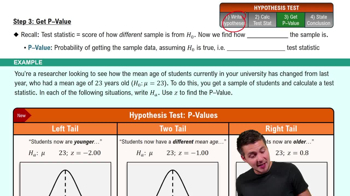
Step 5: Interpret the P-value: it represents the probability of observing a sample mean as extreme as 52.3 seconds or more extreme, assuming the null hypothesis is true. If the P-value is small (typically less than 0.05), conclude that there is sufficient evidence to suggest the wait times have decreased; otherwise, conclude there is not enough evidence.
Verified video answer for a similar problem:
This video solution was recommended by our tutors as helpful for the problem above
Video duration:
8m
Play a video:
0 Comments
Key Concepts
Here are the essential concepts you must grasp in order to answer the question correctly.
Sampling Distribution of the Sample Mean
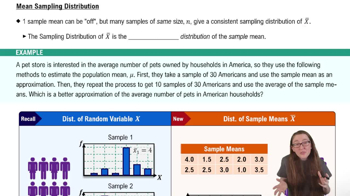
The sampling distribution of the sample mean is the probability distribution of means computed from many random samples of the same size drawn from a population. It shows how sample means vary due to random sampling and is essential for understanding variability and making inferences about the population mean.
The null hypothesis is a statement that there is no effect or difference, serving as a baseline for testing. The P-value measures the probability of observing data as extreme as the sample, assuming the null hypothesis is true. A small P-value indicates strong evidence against the null hypothesis.
Resampling methods, like drawing many random samples from the population data, simulate the null distribution of a test statistic. This approach helps estimate the P-value without relying on strict theoretical assumptions, allowing for hypothesis testing based on empirical data.