Skip to main content
Statistics
My Course
Learn
Exam Prep
AI Tutor
Study Guides
Textbook Solutions
Flashcards
Explore
Try the app
My Course
Learn
Exam Prep
AI Tutor
Study Guides
Textbook Solutions
Flashcards
Explore
Try the app
Back
Two Proportions Hypothesis Test - Excel definitions
You can tap to flip the card.
Null Hypothesis
You can tap to flip the card.
👆
Null Hypothesis
Assumes no difference between two population proportions, serving as the baseline for statistical testing.
Track progress
Control buttons has been changed to "navigation" mode.
1/15
Related flashcards
Related practice
Recommended videos
Two Proportions Hypothesis Test - Excel quiz
Two Proportions Hypothesis Test - Excel
15 Terms
Two Means - Unknown, Unequal Variance
10. Hypothesis Testing for Two Samples
3 problems
Topic
Justin
10. Hypothesis Testing for Two Samples
3 topics
6 problems
Chapter
Brendan
09:31
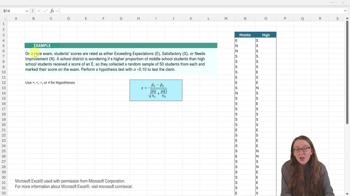
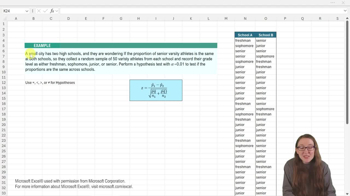
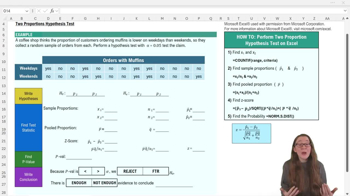
Two Proportions Hypothesis Test - Excel
197
views
1
rank
08:25
Two Proportions Hypothesis Test - Excel Example 1
144
views
2
rank
10:28
Two Proportions Hypothesis Test - Excel Example 2
96
views
1
rank
Terms in this set (15)
Hide definitions
Null Hypothesis
Assumes no difference between two population proportions, serving as the baseline for statistical testing.
Alternative Hypothesis
Represents the claim being tested, suggesting a difference or inequality between two population proportions.
Sample Proportion
Calculated by dividing the count of successes in a sample by the total sample size, reflecting observed frequency.
Pooled Proportion
Combines data from both samples to estimate a shared proportion, used in the denominator of the z-score formula.
Z-Score
Measures how far the difference between sample proportions deviates from the expected value under the null hypothesis.
P-Value
Probability of observing a result as extreme as the test statistic, used to assess evidence against the null hypothesis.
Alpha
Threshold for statistical significance, commonly set at 0.05, guiding the decision to reject or retain the null hypothesis.
Test Statistic
Numerical value calculated from sample data, used to determine the likelihood of the observed outcome under the null hypothesis.
COUNTIF
Excel function that counts cells meeting a specified criterion, useful for tallying categorical responses in data analysis.
NORM.S.DIST
Excel function that returns the cumulative probability for a standard normal distribution, converting z-scores to p-values.
Sample Size
Total number of observations in each group, essential for calculating proportions and variances.
Q Bar
Represents one minus the pooled proportion, used in variance calculations for the z-score denominator.
Left Tail Probability
Area under the normal curve to the left of the test statistic, relevant for one-sided hypothesis tests.
Categorical Data
Data type representing distinct groups or categories, such as yes/no responses, analyzed in proportion tests.
Inferential Statistics
Branch of statistics focused on drawing conclusions about populations based on sample data and hypothesis testing.
 BackBack
 09:31
09:31