 Back
BackChapter 4: Introduction to Probability – Structured Study Notes
Study Guide - Smart Notes
 Tailored notes based on your materials, expanded with key definitions, examples, and context.
Probability: Basic Concepts and Definitions
Events, Sample Space, and Probability Values
Probability is a measure of how likely an event is to occur, expressed as a value between 0 and 1. Understanding the basic terminology is essential for interpreting probability values and solving problems.
Event: Any collection of results or outcomes from a procedure.
Simple Event: An outcome that cannot be broken down further.
Sample Space: The set of all possible simple events or outcomes of a probability experiment.
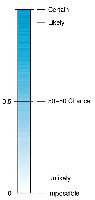
Probability Value: A number between 0 (impossible) and 1 (certain), with values closer to 0 indicating rare events.
Example: Tossing two coins yields the sample space: HH, HT, TH, TT.
Example: Rolling a die yields the sample space: 1, 2, 3, 4, 5, 6.


Probability Notation
Probabilities are denoted as follows:
P(A): Probability of event A occurring.
P(B): Probability of event B occurring.
Approaches to Finding Probability
Three Common Approaches
There are three main approaches to calculating probabilities:
Relative Frequency Approximation: Probability is estimated by conducting or observing a procedure and counting the number of times event A occurs.
Classical Approach: Used when outcomes are equally likely. If a procedure has n equally likely simple events and event A can occur in s ways:
Caution: Only use this approach when outcomes are equally likely.
Subjective Probability: Probability is estimated based on knowledge of relevant circumstances.
Sample Space and Examples
Sample Space Construction
Constructing the sample space is fundamental for probability calculations. For example, if a family has three children, the sample space (order matters) is:
BBB, BBG, BGB, BGG, GBB, GBG, GGB, GGG
Example Questions:
Probability of exactly two boys
Probability of exactly three girls
Probability of at least one girl
Simulations and Law of Large Numbers
Simulations
Simulations are used when classical or frequency approaches are not feasible. A simulation mimics the procedure to produce similar results.
Law of Large Numbers
The law states that as a procedure is repeated many times, the relative frequency probability of an event approaches the actual probability. However, it does not apply to individual outcomes.
Significant Results and Rare Event Rule
Rare Event Rule
If the probability of an observed event is very small under a given assumption, and the event occurs significantly less or more than expected, the assumption is likely incorrect.
Significantly High and Low Results
Significantly High: x successes among n trials is significantly high if .
Significantly Low: x successes among n trials is significantly low if .
Addition Rule and Disjoint Events
Addition Rule
The addition rule is used to find the probability that at least one of two events occurs.

Disjoint (Mutually Exclusive) Events
Events A and B are disjoint if they cannot occur at the same time. For example, selecting a person who is male and female simultaneously is impossible.
Multiplication Rule and Independent Events
Multiplication Rule
The multiplication rule is used to find the probability that two events both occur.
(if A and B are independent)
Independent Events
Two events are independent if the occurrence of one does not affect the probability of the other. For example, rolling two dice or drawing cards with replacement.
Conditional Probability and Dependent Events
Conditional Probability
Conditional probability is the probability of event B occurring given that event A has already occurred.
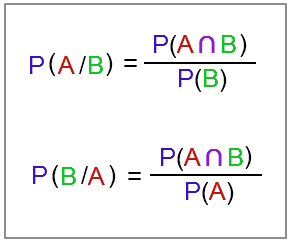
Dependent Events
Events are dependent if the outcome of the first affects the outcome of the second. For example, drawing cards without replacement.
Counting Principles and Probability
Basic Counting Principle
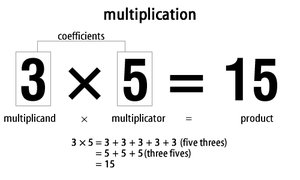
If a procedure can be done in m ways and another in n ways, the total number of ways is m × n.
Example: Tossing a coin and rolling a die: 2 × 6 = 12 possible outcomes.
Factorial Notation
Factorial notation is used to count arrangements:
Permutations and Combinations
Permutation: Arrangement of n objects in a specific order using r objects at a time.
Combination: Selection of r objects from n without regard to order.
Applications and Practice Problems
Probability with Cards, Dice, and Coins
Many probability problems involve cards, dice, and coins. Understanding their sample spaces is crucial.
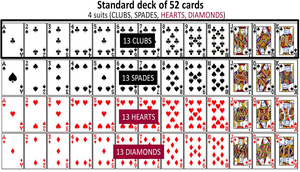
Standard deck: 52 cards, 4 suits, 13 cards per suit.
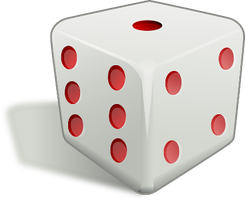
Dice: 6 faces, each equally likely.
Coins: 2 sides, heads and tails.
Example: Probability of Drawing Cards
Probability of drawing an ace from a deck:
Probability of drawing a red card:
Example: Probability of Rolling Dice
Probability of rolling a 3:
Probability of rolling an even number:
Summary Table: Probability Approaches
Approach | Formula | When to Use |
|---|---|---|
Relative Frequency | Empirical data, repeated trials | |
Classical | Equally likely outcomes | |
Subjective | Estimated based on knowledge | Unique or complex situations |
Key Formulas
Probability of an event:
Addition Rule:
Multiplication Rule (Independent):
Conditional Probability:
Permutation:
Combination:
Practice and Applications
Apply these concepts to solve probability problems involving cards, dice, coins, and real-world scenarios such as surveys, medical tests, and manufacturing defects.
Additional info: These notes expand on brief points from the original materials, providing definitions, formulas, and examples for clarity and completeness. Images included are directly relevant to the explanation of sample spaces and probability calculations involving dice, cards, and coins.
