 Back
BackChapter 4: Probability – Structured Study Notes for Statistics Students
Study Guide - Smart Notes
 Tailored notes based on your materials, expanded with key definitions, examples, and context.
Probability
Basic Concepts of Probability
Probability is a fundamental concept in statistics, representing the likelihood of an event occurring. Probabilities are expressed as values between 0 and 1, where 0 indicates impossibility and 1 indicates certainty.
Event: Any collection of results or outcomes of a procedure.
Simple Event: An outcome that cannot be broken down further.
Sample Space: The set of all possible simple events.
Probability Notation: P(A) denotes the probability of event A occurring.
Example: With one birth, the result of a girl or a boy is a simple event. With three births, the sample space consists of eight different simple events (e.g., ggb, gbg, bgg, etc.).
Possible Values of Probability
Probabilities can be expressed as fractions, decimals, or percentages. The closer the value is to 1, the more likely the event is to occur.
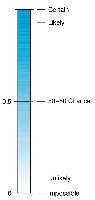
Suggestion: When a probability is not a simple fraction, such as or , express it as a decimal for clarity.

Three Common Approaches to Finding Probability
Classical Approach: Assumes equally likely outcomes. If a procedure has n equally likely simple events and event A can occur in s ways, then .
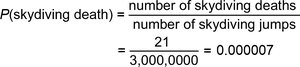
Relative Frequency Approach: Based on observed data. .
Subjective Approach: Based on personal judgment or estimation.
Example: Skydiving Death Probability
In a recent year, there were 3,000,000 skydiving jumps and 21 deaths. Using the relative frequency approach:
Example: Texting While Driving
In a sample of 8,505 drivers, 3,785 texted while driving and 4,720 did not.

Probability calculation:

Law of Large Numbers
The law of large numbers states that as a procedure is repeated many times, the relative frequency probability of an event approaches the actual probability. This law applies to large numbers of trials, not individual outcomes.
Complementary Events
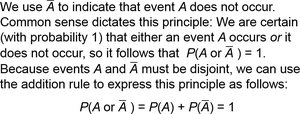
The complement of an event A, denoted as , is the event that A does not occur. The probability of the complement is:
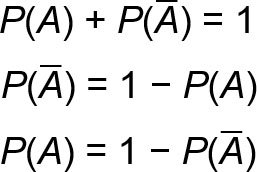
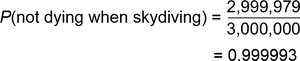
Example: Probability of not dying when skydiving:
Identifying Significant Results with Probabilities
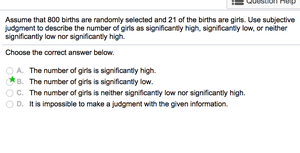
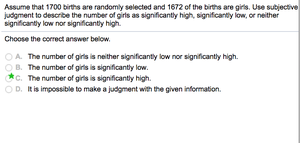
The rare event rule states that if the probability of an observed event is very small (typically ≤ 0.05), and the event occurs significantly less or more than expected, the assumption is likely incorrect.
Significantly High:
Significantly Low:
Addition Rule and Multiplication Rule
Addition Rule
The addition rule is used to find the probability that either event A or event B occurs (or both). The word "or" is associated with addition.
Compound Event: Combines two or more simple events.
Formal Addition Rule:
Disjoint (Mutually Exclusive) Events: Events that cannot occur at the same time.
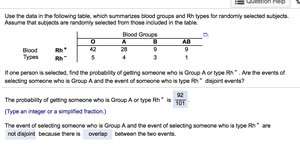
Example: Selecting someone who is Group A or type Rh- from a table of blood groups. The events are not disjoint because there is overlap.
Rule of Complementary Events
For any event A and its complement :
Multiplication Rule
The multiplication rule is used to find the probability that both event A and event B occur. The word "and" is associated with multiplication.
Notation:
Conditional Probability: is the probability of B given A has occurred.
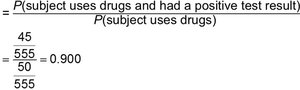
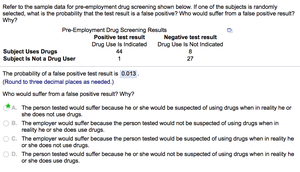
Example: Pre-Employment Drug Screening
Given a table of test results, find :
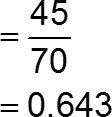
Find :
Example: Drug Test Results
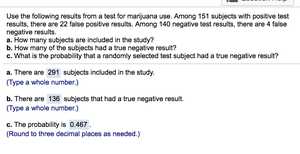
Example: Among 151 subjects with positive test results, 22 were false positives. Among 140 negative test results, 4 were false negatives. Total subjects: 291. True negative results: 136. Probability of true negative: 0.467.
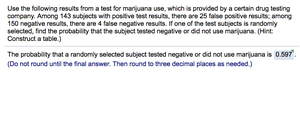
Probability that a randomly selected subject tested negative or did not use marijuana: 0.597.
Independence and the Multiplication Rule
Two events A and B are independent if the occurrence of one does not affect the probability of the other. If not, they are dependent.
Sampling with Replacement: Selections are independent.
Sampling without Replacement: Selections are dependent.
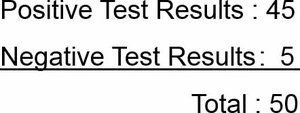
Example: Probability with Replacement
Probability that the first selected person had a positive test result and the second had a negative test result:
With replacement:
Without replacement: Adjust probabilities for the second selection.
Risk and Odds
Risk and Odds for Contingency Tables
Risk and odds are used to compare the likelihood of events in different groups, such as treatment and control groups in clinical studies.
Absolute Risk Reduction: The difference in risk between two groups.
Relative Risk: The ratio of risk in the treatment group to the risk in the control group.
Odds: The ratio of the probability of an event occurring to the probability of it not occurring.
Rates of Mortality, Fertility, and Morbidity
Mortality, Fertility, and Morbidity Rates
These rates are important measures in biostatistics for understanding population health.
Mortality Rate: Number of deaths per unit population (e.g., per 1,000 people).
Fertility Rate: Number of births per unit population.
Morbidity Rate: Number of cases of disease per unit population.
Example: For a particular year, the death rate is 8 per 1,000 people.
Summary of Key Probability Rules
Addition Rule: The word "or" suggests addition. Add probabilities, ensuring no double counting.
Multiplication Rule: The word "and" suggests multiplication. Multiply probabilities, considering dependence or independence.
Complement Rule:
Additional info: These notes expand on brief textbook points with academic context, definitions, and examples to ensure completeness and clarity for exam preparation.
