 Back
BackChapter 5: Probability – Rules, Methods, and Applications
Study Guide - Smart Notes
 Tailored notes based on your materials, expanded with key definitions, examples, and context.
Probability: Rules, Methods, and Applications
Introduction to Probability
Probability is a fundamental concept in statistics that quantifies the likelihood of random phenomena or chance behavior. It allows us to make informed predictions about uncertain outcomes by analyzing long-term patterns and frequencies.
Random Processes and the Law of Large Numbers
Understanding Random Processes
Random process: A scenario where the outcome of any particular trial is unpredictable, but the proportion of a specific outcome stabilizes as the number of trials increases.
Simulation: A technique used to recreate random events to measure how often a goal is observed.
Example: Rolling a die many times and recording the frequency of a particular outcome, such as rolling a four.
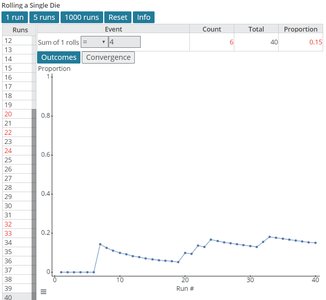
The Law of Large Numbers
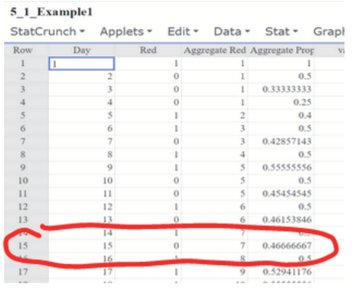
As the number of repetitions of a probability experiment increases, the observed proportion of a certain outcome approaches the true probability of that outcome.
Example: Tracking the proportion of days a traffic light is red during a commute over many days.
The Nonexistent Law of Averages
The Law of Large Numbers does not imply that outcomes will "even out" in the short run.
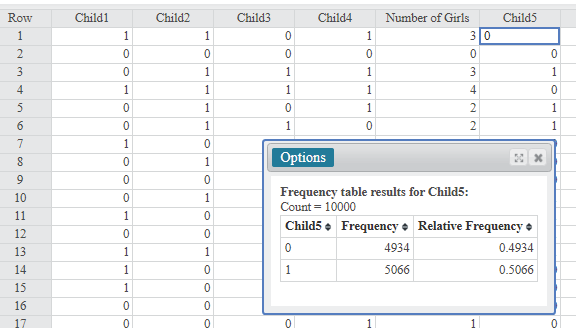
Each trial is independent; past outcomes do not affect future probabilities.
Example: Simulating families with four children and observing the probability of the fifth child being a boy or girl, regardless of previous outcomes.
Basic Probability Concepts
Experiments, Sample Spaces, and Events
Experiment: Any process that can be repeated with uncertain results.
Sample space (S): The set of all possible outcomes.
Event: Any collection of outcomes from a probability experiment (can be simple or compound).
Rules of Probability
For any event E,
The sum of probabilities for all outcomes in the sample space is 1:
Probability model: A table or list showing all possible outcomes and their probabilities, which must satisfy the above rules.
Unusual event: An event with a probability less than 0.05 is typically considered unusual.
Methods for Computing Probability
Empirical (Experimental) Method
Probability is approximated by the relative frequency of an event after many trials:
Classical Method
Used when all outcomes are equally likely.
Subjective Probability
Probability based on personal judgment or experience, not on formal calculations or experiments.
Example: An economist estimating a 20% chance of recession next year.
Addition Rule and Complements
Addition Rule for Disjoint (Mutually Exclusive) Events
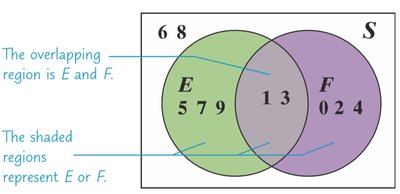
Events are disjoint if they have no outcomes in common.
if E and F are disjoint.
General Addition Rule
For any two events E and F:
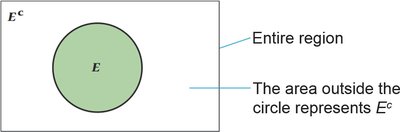
Complement Rule
The complement of event E (denoted ) consists of all outcomes not in E.
Independence and the Multiplication Rule
Independent and Dependent Events
Events E and F are independent if the occurrence of one does not affect the probability of the other.
Events are dependent if the occurrence of one affects the probability of the other.
Disjoint events are not independent.
Multiplication Rule for Independent Events
If E and F are independent,
For n independent events:
At-Least Probabilities
To find the probability that at least one event occurs:
Conditional Probability and the General Multiplication Rule
Conditional Probability
The probability of event E given that event F has occurred is:
General Multiplication Rule
The probability that both E and F occur is:
Counting Techniques
Multiplication Rule of Counting
If a task consists of a sequence of choices, the total number of ways to complete the task is the product of the number of choices at each stage.
Example: If there are 2 appetizers, 4 entrées, and 2 desserts, the number of possible meals is .
Permutations
An ordered arrangement of r objects chosen from n distinct objects (no repetition).
Number of permutations:
Combinations
An unordered selection of r objects from n distinct objects (no repetition).
Number of combinations:
Permutations with Nondistinct Items
Number of arrangements of n objects, where there are groups of indistinguishable objects:
, where are the counts of each indistinguishable type.
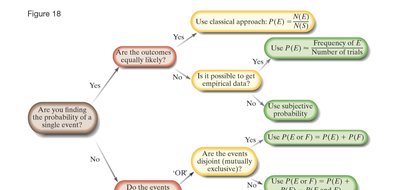
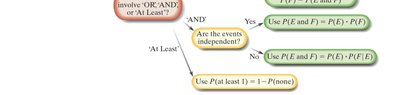
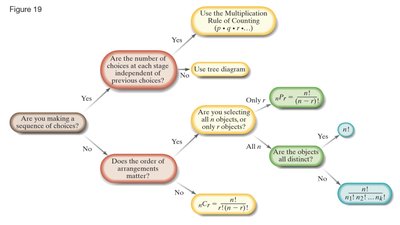
Probability and Counting Decision Flowcharts
These flowcharts help determine which probability rule or counting technique to use based on the structure of the problem.
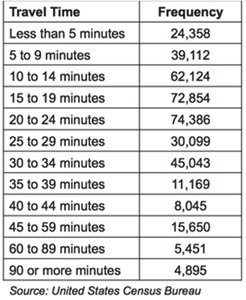
Tabular Data Example: Travel Time to Work
The following table summarizes the frequency of travel times for residents of Hartford County, CT. Such tables are used to compute empirical probabilities.
Travel Time | Frequency |
|---|---|
Less than 5 minutes | 24,358 |
5 to 9 minutes | 39,112 |
10 to 14 minutes | 62,124 |
15 to 19 minutes | 72,854 |
20 to 24 minutes | 74,386 |
25 to 29 minutes | 30,099 |
30 to 34 minutes | 45,043 |
35 to 39 minutes | 11,169 |
40 to 44 minutes | 8,045 |
45 to 59 minutes | 15,650 |
60 to 89 minutes | 5,451 |
90 or more minutes | 4,895 |
Summary of Key Probability Rules
Probabilities are always between 0 and 1.
The sum of probabilities for all outcomes is 1.
Addition Rule for disjoint events:
General Addition Rule:
Complement Rule:
Multiplication Rule for independent events:
