 Back
BackComprehensive Guidance for Elementary Statistics Practice Exam (MAT 170, Triton College)
Study Guide - Smart Notes
 Tailored notes based on your materials, expanded with key definitions, examples, and context.
Q1. Find the class midpoint of the score interval 40-59.
Background
Topic: Frequency Distributions and Class Midpoints
This question tests your understanding of how to find the midpoint of a class interval in a frequency distribution, which is a foundational concept in descriptive statistics.
Key Terms and Formulas
Class Interval: The range of values covered by a class in a frequency distribution (e.g., 40-59).
Class Midpoint Formula:
Step-by-Step Guidance
Identify the lower and upper limits of the class interval. For 40-59, the lower limit is 40 and the upper limit is 59.
Plug these values into the class midpoint formula.
Calculate the sum of the lower and upper limits.
Divide the sum by 2 to find the midpoint.
Try solving on your own before revealing the answer!
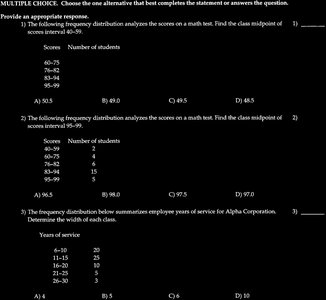
Q2. Find the class midpoint of the score interval 95-99.
Background
Topic: Frequency Distributions and Class Midpoints
This question is similar to Q1 and reinforces your ability to calculate class midpoints for different intervals.
Key Terms and Formulas
Class Interval: 95-99
Class Midpoint Formula:
Step-by-Step Guidance
Identify the lower (95) and upper (99) limits of the interval.
Insert these values into the midpoint formula.
Add the lower and upper limits together.
Divide the result by 2 to get the midpoint.
Try solving on your own before revealing the answer!
Q3. Determine the width of each class for the frequency distribution of years of service.
Background
Topic: Frequency Distributions – Class Width
This question tests your ability to determine the width of each class in a grouped frequency distribution, which is important for constructing histograms and understanding data grouping.
Key Terms and Formulas
Class Width: The difference between the lower limits (or upper limits) of two consecutive classes.
Class Width Formula:
Step-by-Step Guidance
Identify the lower limits of two consecutive classes (e.g., 11-15 and 16-20).
Subtract the lower limit of the first class from the lower limit of the second class.
The result is the class width.
Try solving on your own before revealing the answer!
Q4. Find the class midpoint for the home sale price class 225.0-269.9 (in thousands of dollars).
Background
Topic: Frequency Distributions and Class Midpoints
This question asks you to apply the class midpoint formula to a real-world context (home prices).
Key Terms and Formulas
Class Interval: 225.0-269.9
Class Midpoint Formula:
Step-by-Step Guidance
Identify the lower (225.0) and upper (269.9) limits of the class interval.
Add these two values together.
Divide the sum by 2 to find the midpoint.
Try solving on your own before revealing the answer!
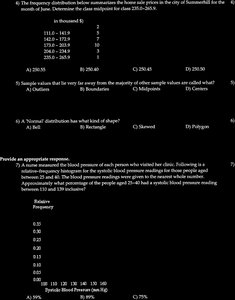
Q5. What are values that lie very far away from the majority of other sample values called?
Background
Topic: Descriptive Statistics – Outliers
This question tests your understanding of terminology related to unusual data values in a dataset.
Key Terms
Outlier: A value that is much greater or much less than the other values in a dataset.
Boundary: The dividing point between classes in a frequency distribution.
Midpoint: The center value of a class interval.
Cluster: A group of similar data points.
Step-by-Step Guidance
Recall the definition of an outlier and how it differs from other terms listed.
Think about which term best describes a value that is far from the rest of the data.
Try solving on your own before revealing the answer!
Q6. A 'normal' distribution has what kind of shape?
Background
Topic: Probability Distributions – Normal Distribution
This question tests your knowledge of the graphical shape of the normal distribution, which is fundamental in statistics.
Key Terms
Normal Distribution: A bell-shaped, symmetric probability distribution.
Histogram: A bar graph representing frequency distribution.
Polygon: A line graph connecting midpoints of histogram bars.
Rectangle: Not typically used to describe the normal distribution.
Step-by-Step Guidance
Recall the typical shape of the normal distribution curve.
Match the description to the correct geometric term.
Try solving on your own before revealing the answer!
Final Answer Key (Sample for Q1):
Q1: The class midpoint for 40-59 is 49.5.
We added 40 and 59, then divided by 2: (40 + 59) / 2 = 49.5.
