 Back
BackConditional Probability and the Multiplication Rule: Study Notes
Study Guide - Smart Notes
 Tailored notes based on your materials, expanded with key definitions, examples, and context.
Conditional Probability and the Multiplication Rule
Conditional Probability
Conditional probability refers to the probability of an event occurring given that another event has already occurred. This concept is fundamental in understanding how probabilities change when additional information is available.
Definition: The probability of event B occurring given that event A has occurred is denoted as P(B|A).
Formula:
Example: If two cards are drawn from a deck without replacement, the probability that the second card is a queen given that the first card is a king is , since there are 51 cards left and 4 queens remaining.
Independent and Dependent Events
Events can be classified as independent or dependent based on whether the occurrence of one affects the probability of the other.
Independent Events: The occurrence of one event does not affect the probability of the other. For independent events, .
Dependent Events: The occurrence of one event changes the probability of the other. For dependent events, .
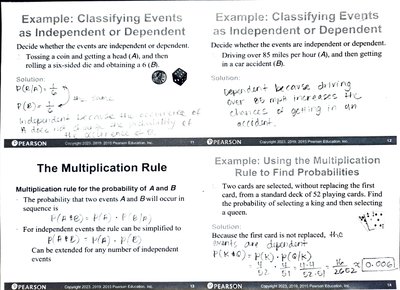
Example: Tossing a coin and rolling a die are independent events, since the outcome of one does not affect the other.
Example: Drawing a card from a deck and not replacing it before drawing another card are dependent events, since the first draw changes the composition of the deck.
Example: Driving over 85 miles per hour and getting in a car accident are dependent events, as speeding increases the likelihood of an accident.
The Multiplication Rule
The multiplication rule is used to find the probability that two or more events occur in sequence. The rule differs depending on whether the events are independent or dependent.
General Multiplication Rule:
For Independent Events:
Extension: This rule can be extended to any number of independent events:
Examples: Using the Multiplication Rule to Find Probabilities
Applying the multiplication rule allows calculation of probabilities for sequences of events, both independent and dependent.
Example (Dependent Events): Two cards are drawn from a deck without replacement. The probability of drawing a king and then a queen is .
Example (Independent Events): Tossing a coin and rolling a die. The probability of getting a head and then a 6 is .
Key Points:
For dependent events, use the conditional probability in the multiplication rule.
For independent events, simply multiply the probabilities of each event.
Summary Table: Independent vs. Dependent Events
Type of Events | Definition | Multiplication Rule | Example |
|---|---|---|---|
Independent | Occurrence of one does not affect the other | Tossing a coin and rolling a die | |
Dependent | Occurrence of one affects the probability of the other | Drawing two cards without replacement |
