 Back
BackL10 Confidence Intervals for a Population Proportion
Study Guide - Smart Notes
 Tailored notes based on your materials, expanded with key definitions, examples, and context.
Confidence Intervals for a Population Proportion
Introduction
Estimating the proportion of a population that possesses a certain characteristic is a fundamental task in statistics, especially when dealing with categorical data. Confidence intervals provide a range of plausible values for the true population proportion based on sample data, allowing for quantification of uncertainty in estimation.
Sampling Distribution of a Sample Proportion
Definition and Properties
Sample Proportion (\( \hat{p} \)): The proportion of observations in a sample that fall into a specified category.
Population Proportion (\( p \)): The true proportion of the population with the characteristic of interest.
Sampling Distribution: If repeated random samples of size \( n \) are taken from a population with proportion \( p \), the distribution of the sample proportions \( \hat{p} \) is approximately normal for large \( n \), with mean \( p \) and standard deviation \( \sqrt{\frac{p(1-p)}{n}} \).
This approximation is best when \( n \) is large and \( p \) is not close to 0 or 1.
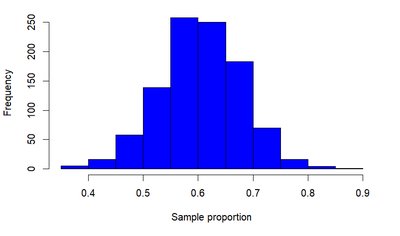
Example: If the true proportion of a population supporting a candidate is 0.62, and samples of size 40 are repeatedly taken, the sample proportions will be distributed approximately normally around 0.62.
Constructing a 95% Confidence Interval for a Population Proportion
Formula and Interpretation
The general form for a 95% confidence interval for a population proportion is:
Where:
\( \hat{p} \) = sample proportion
\( n \) = sample size
1.96 is the z-value corresponding to a 95% confidence level
The interval provides a range in which the true population proportion is likely to fall, with 95% confidence.
Example: In a consumer test, 56 out of 80 people reported improvement from a product. The sample proportion is \( \hat{p} = \frac{56}{80} = 0.70 \). The 95% confidence interval is:
Sample Size Calculation for a Desired Confidence Interval Width
Determining Required Sample Size
To estimate a population proportion within a specified margin of error (E) at a given confidence level, the required sample size \( n \) can be calculated as:
\( p^* \) is a prior estimate of the proportion (often 0.5 for maximum variability if unknown).
For a 95% confidence interval, \( z = 1.96 \); for a 99% confidence interval, \( z = 2.58 \).
Example: To estimate a proportion to within 2% (E = 0.02) with 99% confidence and no prior estimate, use \( p^* = 0.5 \):
Worked Examples
Example 1: Confidence Interval Calculation
Scenario: 120 out of 250 gift vouchers expired unused.
\( \hat{p} = \frac{120}{250} = 0.48 \)
95% CI:
Interpretation: We are 95% confident that the true proportion of expired vouchers is within the calculated interval.
Example 2: Hypothesis Testing Using Confidence Interval
Question: Is there evidence that at least 40% of vouchers expire unused?
If the lower bound of the confidence interval is above 0.40, there is evidence to support the claim.
Example 3: Changing Confidence Levels
For a 99% confidence interval, replace 1.96 with 2.58 in the formula:
Summary Table: Sample Size and Error
The following table shows how sample size affects the margin of error for a 95% confidence interval when \( p = 0.5 \):
Sample Size (n) | Error (Margin of Error) |
|---|---|
100 | 0.098 |
1000 | 0.031 |
2000 | 0.022 |
4000 | 0.015 |
Key Points
Confidence intervals for proportions are based on the normal approximation to the sampling distribution of \( \hat{p} \).
The width of the interval depends on the sample size and the estimated proportion.
For different confidence levels, use the appropriate z-value (e.g., 1.96 for 95%, 2.58 for 99%).
Sample size calculations ensure the desired precision in estimation.
