 Back
BackDiscrete and Binomial Probability Distributions: Study Guide
Study Guide - Smart Notes
 Tailored notes based on your materials, expanded with key definitions, examples, and context.
Discrete Probability Distributions
Discrete and Continuous Random Variables
A random variable is a numerical measure of the outcome of a probability experiment, determined by chance. Random variables are denoted by capital letters such as X.
Discrete random variable: Has a finite or countable number of values. These values can be plotted on a number line with space between each point.
Continuous random variable: Has infinitely many values, which can be plotted on a line in an uninterrupted fashion.
Example: For a bag of M&M’s:
Mass of each M&M: Continuous
Number of pieces of candy: Discrete
Diameter of each piece: Continuous
Number of distinct colors: Discrete
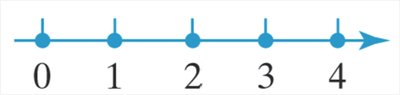
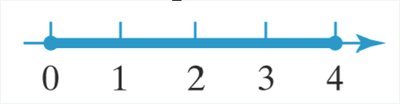
Discrete Probability Distributions
The probability distribution of a discrete random variable X provides the possible values of X and their corresponding probabilities. It can be represented as a table, graph, or mathematical formula.
Rule 1: The sum of all probabilities must equal 1:
Rule 2: Each probability must be between 0 and 1:
Example: Chuck-A-Luck game (profit from a $1 bet):
Number of Dice Matching | Profit | Probability |
|---|---|---|
0 | -$1 | 0.5787 |
1 | $1 | 0.3472 |
2 | $2 | 0.0695 |
3 | $3 | 0.0046 |
Graphing Discrete Probability Distributions
Discrete probability distributions can be visualized using bar graphs, where each possible value of the random variable is represented by a bar whose height corresponds to its probability.
Mean of a Discrete Random Variable
The mean (or expected value) of a discrete random variable X is calculated as:
Interpretation: If an experiment is repeated many times, the average value of X will approach the mean .
Example: For the Chuck-A-Luck game, the mean profit is calculated using the table above.
Expected Value
The expected value E(X) is the long-run average outcome of a random variable. It is interpreted the same way as the mean.
Example: If a property is purchased and resold with various probabilities for different sale prices, the expected profit is calculated by summing the products of each profit and its probability.
Standard Deviation of a Discrete Random Variable
The standard deviation measures the spread of the values of a discrete random variable:
Example: For the Chuck-A-Luck game, use the table to compute the standard deviation.
The Binomial Probability Distribution
Binomial Probability Experiments
A binomial experiment is defined by the following criteria:
Performed a fixed number of times (trials)
Trials are independent
Each trial has two mutually exclusive outcomes: success or failure
Probability of success is constant for each trial
Notation:
n: Number of trials
p: Probability of success
X: Number of successes in n trials
Example: Rolling dice, selecting students, or flights arriving on time can be binomial experiments if they meet the criteria above.
Constructing Binomial Probability Distributions
Binomial probability distributions can be constructed using tree diagrams to enumerate all possible outcomes and count the number of successes.
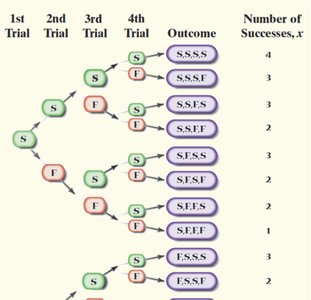
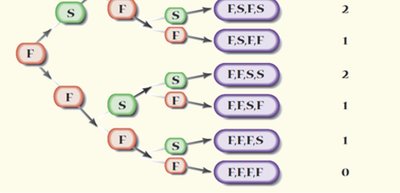
Binomial Probability Distribution Function
The probability of obtaining x successes in n independent trials is given by:
where is the binomial coefficient.
Example: In a sample of 30 adults, the probability that exactly 20 believe divorce is acceptable can be calculated using the binomial formula.
Mean and Standard Deviation of a Binomial Random Variable
The mean and standard deviation for a binomial random variable are:
Example: In a sample of 500 adults, if 58% believe divorce is acceptable, the mean and standard deviation can be calculated using the formulas above.
Graphing Binomial Probability Distributions
Binomial distributions can be visualized using bar graphs. As the number of trials n increases, the distribution becomes bell-shaped, especially if .
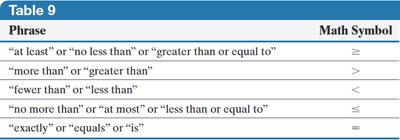
Interpreting Probability Phrases
Common probability phrases correspond to mathematical symbols:
Phrase | Math Symbol |
|---|---|
at least / no less than / greater than or equal to | ≥ |
more than / greater than | > |
fewer than / less than | < |
no more than / at most / less than or equal to | ≤ |
exactly / equals / is | = |
Using the Mean, Standard Deviation, and Empirical Rule
To determine if a result is unusual in a binomial experiment, compare the observed value to the mean and standard deviation. If the result lies far from the mean (e.g., more than two standard deviations), it may be considered unusual.
Additional info: The notes above expand on brief points with academic context, definitions, and examples to ensure completeness and clarity for exam preparation.
