 Back
BackEstimating Parameters and Determining Sample Sizes
Study Guide - Smart Notes
 Tailored notes based on your materials, expanded with key definitions, examples, and context.
Estimating Parameters and Determining Sample Sizes
Estimating a Population Proportion
Estimating a population proportion involves using sample data to infer the true proportion of a characteristic in a population. The sample proportion is the best point estimate for the population proportion, and confidence intervals provide a range of plausible values for the population parameter.
Point Estimate: A single value used to approximate a population parameter. For proportions, the sample proportion \( \hat{p} \) is the best point estimate of the population proportion \( p \).
Example: If 43% of 1487 surveyed adults have a Facebook page, the point estimate for the population proportion is \( \hat{p} = 0.43 \).
Confidence Intervals for a Population Proportion
A confidence interval (CI) is a range of values used to estimate the true value of a population parameter. Common confidence levels are 90%, 95%, and 99%.
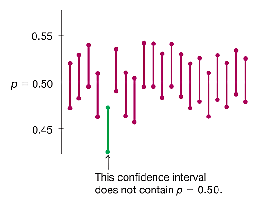
Confidence Level: The probability (1 − α) that the CI contains the population parameter if the process is repeated many times. For example, a 95% confidence level means that 95% of such intervals will contain the true parameter.
Correct Interpretation: "We are 95% confident that the interval from 0.405 to 0.455 contains the true value of the population proportion \( p \)."
Process Success Rate: Over many samples, the proportion of intervals that contain the true parameter equals the confidence level.
Critical Values and the Standard Normal Distribution
Critical values are z-scores that separate unlikely sample statistics from likely ones, based on the chosen confidence level. The value \( z_{\alpha/2} \) is used to construct confidence intervals.
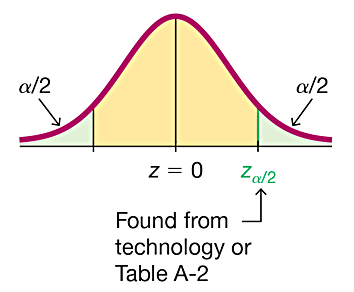
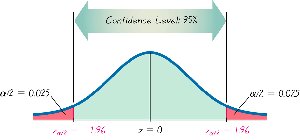
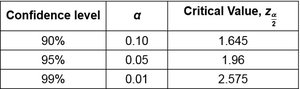
Common Critical Values: For a 95% confidence level, \( z_{\alpha/2} = 1.96 \). Other common values are shown in the table below.
Confidence level | α | Critical Value, \( z_{\alpha/2} \) |
|---|---|---|
90% | 0.10 | 1.645 |
95% | 0.05 | 1.96 |
99% | 0.01 | 2.575 |
Margin of Error for Proportions
The margin of error (E) quantifies the maximum likely difference between the sample proportion and the true population proportion at a given confidence level.
Formula:
where \( \hat{q} = 1 - \hat{p} \), \( n \) is the sample size, and \( z_{\alpha/2} \) is the critical value.

Conditions for Constructing a Confidence Interval for a Proportion
The sample must be a simple random sample.
The binomial distribution conditions are satisfied (fixed number of independent trials, two outcomes, constant probability).
There are at least 5 successes and 5 failures in the sample.
Determining Sample Size for Estimating a Population Proportion
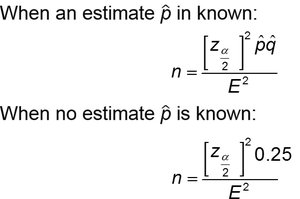
To estimate a population proportion with a specified margin of error and confidence level, the required sample size can be calculated using the following formulas:
If an estimate \( \hat{p} \) is known:
If no estimate is known:
Estimating a Population Mean
Estimating a Population Mean (σ Not Known)
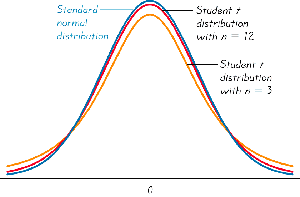
When the population standard deviation (σ) is unknown, the Student t distribution is used to construct confidence intervals for the population mean (μ). The t distribution accounts for the extra variability in small samples.
Degrees of Freedom (df): The number of independent values that can vary in the sample, calculated as \( df = n - 1 \).
Margin of Error (E):
Confidence Interval:
Properties of the t Distribution:
Different for each sample size (n).
Symmetric and bell-shaped, but wider than the normal distribution for small n.
Mean of t = 0; standard deviation > 1 and depends on n.
As n increases, the t distribution approaches the normal distribution.
Estimating a Population Mean (σ Known)
If the population standard deviation (σ) is known and the population is normally distributed or the sample size is large (n > 30), the normal (z) distribution is used.
Margin of Error (E):
Confidence Interval:
Choosing the Appropriate Distribution
Use the normal (z) distribution: σ known and population is normal or n > 30.
Use the t distribution: σ unknown and population is normal or n > 30.
Use nonparametric methods or bootstrapping: Population is not normal and n ≤ 30.
Additional info: These methods are foundational for inferential statistics, allowing researchers to make evidence-based conclusions about population parameters from sample data. Proper interpretation and application of confidence intervals and sample size calculations are essential for valid statistical inference.
