 Back
BackFundamental Counting Principle and Basic Probability Concepts
Study Guide - Smart Notes
 Tailored notes based on your materials, expanded with key definitions, examples, and context.
Fundamental Counting Principle
Definition and Application
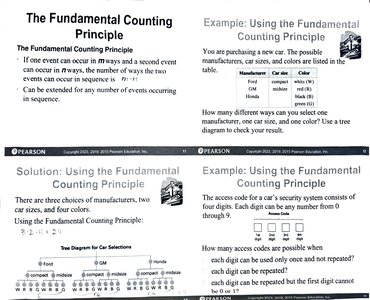
The Fundamental Counting Principle is a foundational concept in probability and combinatorics. It states that if one event can occur in m ways and a second event can occur in n ways, then the two events can occur in sequence in m × n ways. This principle can be extended to any number of events occurring in sequence.
Key Point: Multiply the number of ways each event can occur to find the total number of possible outcomes.
Example: If you have 3 manufacturers, 2 car sizes, and 4 colors, the total number of car options is .
Examples of the Fundamental Counting Principle
Car Selection: Choosing one manufacturer, one car size, and one color from given options.
Access Codes: For a 4-digit code where each digit can be 0-9:
If digits can repeat:
If digits cannot repeat:
If the first digit cannot be 0 or 1 (so 8 choices), but others can repeat:
Types of Probability
Classical (Theoretical) Probability
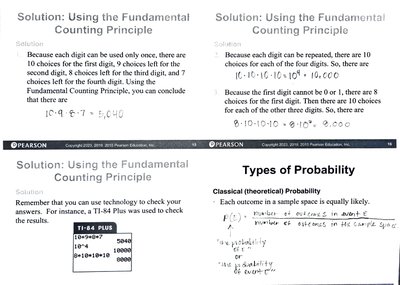
Classical probability applies when all outcomes in the sample space are equally likely. The probability of an event E is:
Example: Rolling a fair six-sided die. Probability of rolling a 3:
Empirical (Statistical) Probability
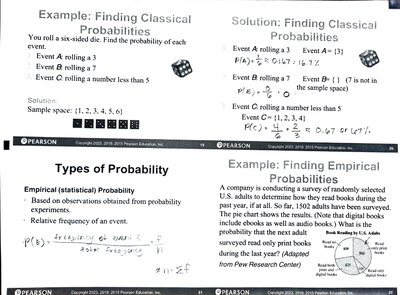
Empirical probability is based on observations from experiments or collected data. It is calculated as:
Example: If 560 out of 1502 surveyed adults read only print books,
Subjective Probability
Subjective probability is based on intuition, educated guesses, or estimates rather than precise calculations or experiments.
Example: A doctor estimates a 90% chance of recovery for a patient based on experience.
Sample Space and Events
Sample Space
The sample space is the set of all possible outcomes of a probability experiment.
Example: For a die roll, the sample space is {1, 2, 3, 4, 5, 6}.
Simple and Compound Events
Simple Event: An event with only one outcome (e.g., rolling a 3).
Compound Event: An event with more than one outcome (e.g., rolling an even number).
Complementary Events
Definition and Calculation
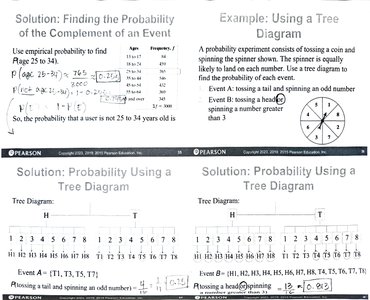
The complement of event E (denoted E') is the set of all outcomes in the sample space that are not in E. The probabilities of an event and its complement always sum to 1:
or
Example: If the probability of a user being 25-34 years old is 0.255, then the probability of not being 25-34 is .
Range of Probabilities Rule
The probability of any event E is always between 0 and 1, inclusive:
Impossible event:
Certain event:
Tree Diagrams
Using Tree Diagrams to Find Probabilities
Tree diagrams are visual tools used to list all possible outcomes of a sequence of events. They are especially useful for multi-stage experiments.
Example: Tossing a coin and spinning a spinner with 8 numbers. Each branch represents a possible outcome (e.g., H1, H2, ..., T8).
Application: To find the probability of tossing a tail and spinning an odd number, count the relevant branches and divide by the total number of outcomes.
Law of Large Numbers
The Law of Large Numbers states that as an experiment is repeated many times, the empirical probability of an event approaches its theoretical probability.
Example: Tossing a coin many times, the proportion of heads will get closer to 0.5 as the number of tosses increases.
Summary Table: Types of Probability
Type | Definition | Example |
|---|---|---|
Classical | All outcomes equally likely | Rolling a die |
Empirical | Based on observed data | Survey results |
Subjective | Based on intuition/estimation | Doctor's prognosis |
