 Back
BackMeasures of Relative Standing and Boxplots: Describing, Exploring, and Comparing Data
Study Guide - Smart Notes
 Tailored notes based on your materials, expanded with key definitions, examples, and context.
Measures of Relative Standing and Boxplots
Introduction
This section explores statistical tools used to describe the position of individual data values within a data set. Key concepts include z scores, percentiles, quartiles, and the construction and interpretation of boxplots. These measures help compare data values, identify outliers, and summarize data distributions.
z Scores
Definition and Calculation
A z score (also called a standard score or standardized value) indicates how many standard deviations a data value (x) is above or below the mean. It is calculated as follows:
Sample z score:
Population z score:
Round z scores to two decimal places.
Properties of z Scores
A z score shows the number of standard deviations a value is from the mean.
z scores are unitless.
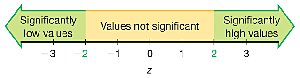
A value is significantly low if and significantly high if .
If a value is less than the mean, its z score is negative.
Example: Comparing Data Values
Suppose we compare a body temperature of 99°F and a quarter weighing 5.7790 g. By converting both to z scores, we find:
99°F: (1.29 standard deviations above the mean)
5.7790 g: (2.26 standard deviations above the mean)
The quarter's weight is more extreme relative to its data set.
Using z Scores to Identify Significant Values
Significantly low:
Significantly high:
Not significant:
For example, an earthquake magnitude of 4.01 with a mean of 2.572 and standard deviation of 0.651 yields , which is significantly high.
Percentiles
Definition and Interpretation
Percentiles divide a data set into 100 groups, each containing about 1% of the values. The kth percentile, , is the value below which k% of the data fall.
Finding the Percentile of a Data Value
To find the percentile for a value x:
Count the number of values less than x.
Divide by the total number of values, multiply by 100, and round to the nearest whole number.
Example: If 36 out of 50 wait times are less than 45 minutes, then 45 minutes is at the 72nd percentile ().
Notation
n: Total number of values
k: Percentile (e.g., for the 25th percentile, k = 25)
L: Locator (position in the sorted list)
Pk: kth percentile value
Converting a Percentile to a Data Value
To find the value at the kth percentile:
Compute
If L is not a whole number, round up to the next whole number. The value at this position is .
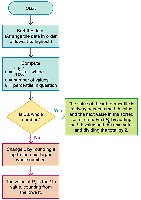
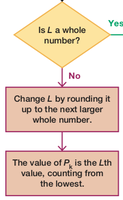
Example: For in a list of 50 values, ; round up to 13. The 13th value is $P_{25}$.
Quartiles
Definition and Description
Quartiles divide a data set into four groups, each containing about 25% of the values:
Q1: First quartile (same as ), separates the lowest 25% from the rest.
Q2: Second quartile (same as or the median), separates the lowest 50% from the highest 50%.
Q3: Third quartile (same as ), separates the lowest 75% from the highest 25%.
Note: There is not universal agreement on the exact procedure for calculating quartiles; results may vary by method or technology.
Statistics Defined Using Quartiles and Percentiles
Interquartile Range (IQR):
Semi-interquartile Range:
Midquartile:
10–90 Percentile Range:
5-Number Summary
Definition and Example
The 5-number summary consists of:
Minimum
First quartile ()
Median ()
Third quartile ()
Maximum
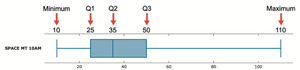
Example: For "Space Mountain" wait times, the 5-number summary is 10, 25, 35, 50, and 110 minutes.
Boxplots (Box-and-Whisker Diagrams)
Definition and Construction
A boxplot is a graphical summary of data based on the 5-number summary. It consists of a box from to , a line at the median (), and "whiskers" extending to the minimum and maximum values.
Find the 5-number summary.
Draw a line from the minimum to the maximum value.
Draw a box from to with a line at .
Skewness
Identifying Skewness with Boxplots
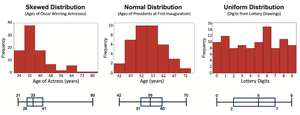
A distribution is skewed if it is not symmetric and extends more to one side. Boxplots can help identify skewness:
Skewed right: Longer whisker on the right
Skewed left: Longer whisker on the left
Symmetric: Whiskers of similar length
Identifying Outliers and Modified Boxplots
Procedure for Identifying Outliers
Find , ,
Compute
Calculate
A value is an outlier if it is below or above
Example: For "Space Mountain" data, , . Outliers are values ≤ -12.5 or ≥ 87.5. Thus, 105 and 110 are outliers.
Modified Boxplots
A modified boxplot marks outliers with a special symbol (e.g., asterisk) and extends the whiskers only to the most extreme non-outlier values.
