 Back
BackCH. 6 Normal Probability Distributions and Sampling Distributions: Study Guide
Study Guide - Smart Notes
 Tailored notes based on your materials, expanded with key definitions, examples, and context.
Normal Probability Distributions
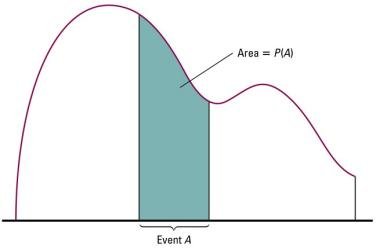
Density Curves and Continuous Probability Distributions
In statistics, a density curve is a smooth curve that represents the distribution of a continuous variable. The area under the curve for a given interval represents the probability of the variable falling within that interval. The function describing the density curve is called the probability density function (p.d.f.).
Continuous Probability Distribution: Satisfies three conditions:
The random variable is continuous.
The probability density function f(x) ≥ 0 for all x.
The total area under the p.d.f. curve is 1.
Uniform Distribution
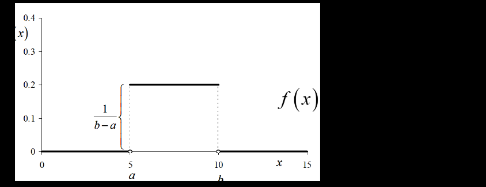
A uniform distribution is a continuous probability distribution where all outcomes are equally likely within a certain interval [a, b]. The graph of a uniform distribution is rectangular.
Probability Density Function:
Area Calculation: Area = height × width
Example: Waiting Time at Subway
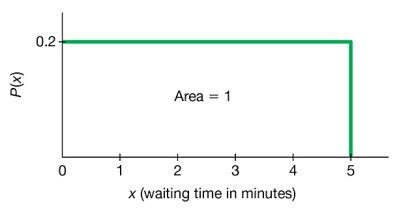
Waiting time is uniformly distributed between 0 and 5 minutes.
Height of the distribution:
Probability of waiting more than 2 minutes:
Normal Distribution
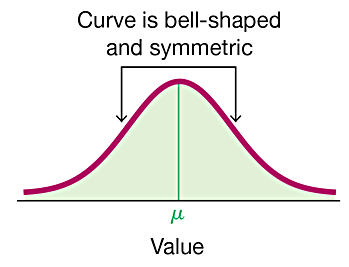
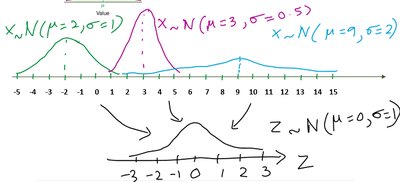
A normal distribution is a continuous probability distribution characterized by its bell-shaped, symmetric curve. It is defined by its mean (μ) and standard deviation (σ).
Symmetric about the mean μ.
The spread depends on σ; larger σ means a flatter, more spread-out curve.
Probability density function:
Standard Normal Distribution
The standard normal distribution is a normal distribution with mean 0 and standard deviation 1. Values from any normal distribution can be standardized using the z-score formula.
Standard normal curve is used to find probabilities and percentiles.
Z-score formula:
Finding Probabilities Using the Normal Distribution
Probabilities are found by calculating the area under the normal curve for a given range of values.
Use statistical software (e.g., StatCrunch) or tables to find probabilities for given z or x values.
For probability between two values: , calculate the area between a and b.
Example: Toyota Car Battery Lifetime
Mean = 45 months, σ = 8 months
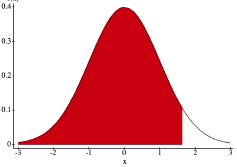
Probability battery fails within 36 months:
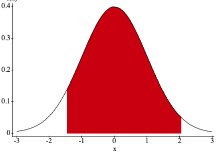
Probability battery lasts between 36 and 50 months:
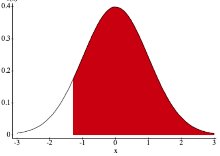
Probability battery lasts 55 months or longer:
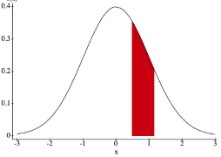
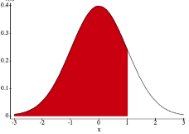
Visualizing Probabilities on the Normal Curve
Shaded regions on the normal curve represent the probability for a given range.
Percentiles and Critical Values
Percentiles and critical values are important for hypothesis testing and confidence intervals.
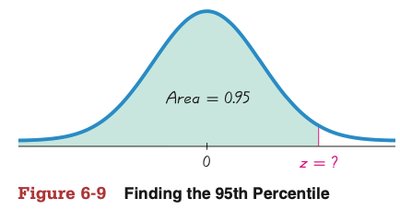
Given a probability (area), find the corresponding z-score or x value.
95th percentile (P95):
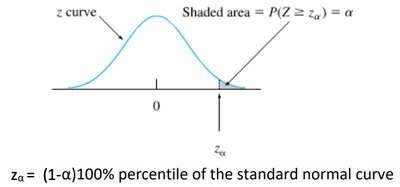
Critical value : The z-score for which the area to the right is α.
Example: Bone Density Score
Find the score corresponding to the 95th percentile:
Find scores separating the bottom and top 2.5%: and
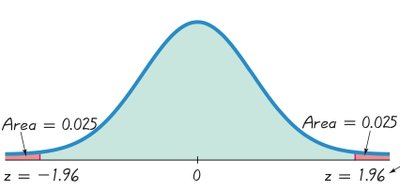
Sampling Distributions and Estimators
Sampling Distribution of the Sample Mean
The sampling distribution of a statistic is the probability distribution of that statistic based on all possible samples from the population.
The mean of the sample means equals the population mean:
The standard deviation of the sample means:
Example: Heights of Students
Sample | Heights | Sample Mean (𝑥̅) |
|---|---|---|
A,B | 76,78 | 77.0 |
A,C | 76,79 | 77.5 |
A,D | 76,81 | 78.5 |
A,E | 76,86 | 81.0 |
B,C | 78,79 | 78.5 |
B,D | 78,81 | 79.5 |
B,E | 78,86 | 82.0 |
C,D | 79,81 | 80.0 |
C,E | 79,86 | 82.5 |
D,E | 81,86 | 83.5 |
Sampling Distribution of Sample Proportion
The sampling distribution of sample proportion describes the distribution of sample proportions from all possible samples.
Sample proportion:
Population proportion:
Mean:
Standard deviation:
Shape is normal if and
Central Limit Theorem
Statement and Applications
The Central Limit Theorem (CLT) states that if the sample size is large enough (n ≥ 30), the sampling distribution of the sample mean is approximately normal, regardless of the population's distribution.
If population is normal:
If n ≥ 30:
For individual values:
For sample means:
Example: Water Taxi Capacity
Mean weight of men: 182.9 lb, σ = 40.8 lb
Probability individual man weighs > 140 lb:
Probability average weight of 25 men > 140 lb:
Conclusion: Capacity is not safe; probability of overloading is 1.
Example: SAT Scores
Mean = 1511, σ = 312
Probability individual score > 1600:
Probability average score of 36 students > 1600:
98th percentile for average score of 45 students:
Summary Table: Key Formulas
Concept | Formula |
|---|---|
Z-score (individual) | |
Z-score (sample mean) | |
Sample mean std. dev. | |
Sample proportion std. dev. | |
Uniform distribution p.d.f. | for |
Normal distribution p.d.f. |
