 Back
BackNormal Probability Distributions and Their Applications
Study Guide - Smart Notes
 Tailored notes based on your materials, expanded with key definitions, examples, and context.
Normal Probability Distributions
Standard Normal Distribution
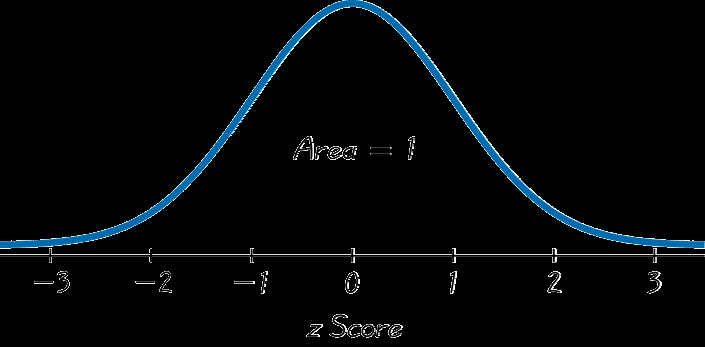
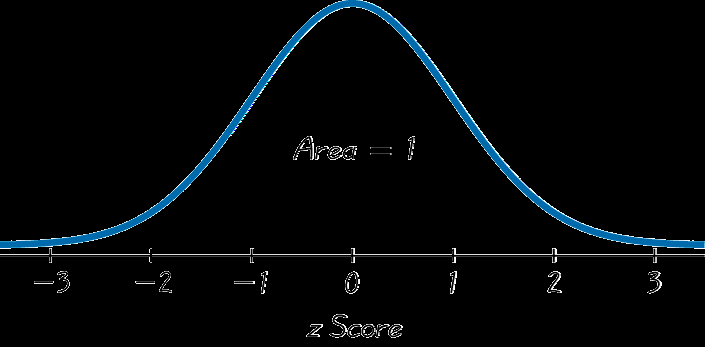
The standard normal distribution is a special case of the normal probability distribution with a mean of 0 and a standard deviation of 1. It is widely used in statistics for calculating probabilities and z-scores.
Bell-shaped curve: The graph is symmetric and centered at zero.
Mean (μ): 0
Standard deviation (σ): 1
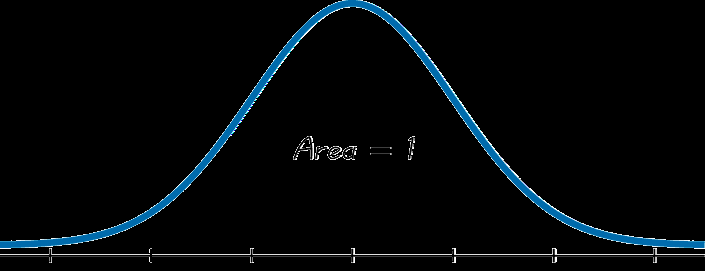
Total area under the curve: 1 (corresponds to probability 1)
Because the total area under the curve is 1, the area under the curve between two points represents the probability of a value falling within that range.
z-Scores
A z-score measures how many standard deviations a value is from the mean. Each unit on the z-scale represents one standard deviation. The formula for a z-score is:
Unusual events: Typically, z-scores less than -2 or greater than 2 are considered unusual, but the threshold may vary depending on context.
Finding Areas and Probabilities
To find the probability that a value falls within a certain range, use the area under the curve between the corresponding z-scores. Calculators and statistical tables can be used for this purpose. For example, the calculator function normalcdf(L.B., U.B., μ, σ) gives the area (probability) between two bounds.
Example: Bone Density Test
Context: Bone density z-scores are normally distributed with μ = 0 and σ = 1.
Find the probability of a reading less than 1.27: Use normalcdf(-∞, 1.27, 0, 1).
Find the probability of a reading above -1.00: Use normalcdf(-1.00, ∞, 0, 1).
Probability of osteopenia (between -1.00 and -2.50): Use normalcdf(-2.50, -1.00, 0, 1).
Finding Probabilities for Given z-Scores
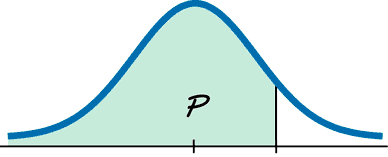
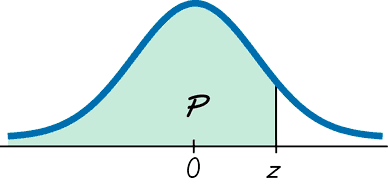
To find the probability for a given z-score, calculate the area under the curve to the left (for less than) or to the right (for greater than) that z-score.
Less than z = -1.50: Area to the left of -1.50
Greater than z = 2.22: Area to the right of 2.22
Between z = -1.20 and z = 1.95: Area between these two z-scores
Finding z-Scores for Given Probabilities
To find the z-score corresponding to a given cumulative probability (area to the left), use the InvNorm function:
InvNorm(area, μ, σ): Returns the z-score for the specified area to the left.
Examples:
Find the z-score for area = 0.7542
Find the z-score for area = 0.2222
Find the z-score for the top 40% (area to the left = 0.60)
Find the z-score for the top 95% (area to the left = 0.05 for the lower tail, or 0.95 for the upper tail)
Applications of Normal Distributions
Standard vs. Non-Standard Normal Distributions
The standard normal distribution uses μ = 0 and σ = 1. A non-standard normal distribution has any mean μ and standard deviation σ. To use standard normal tables or calculator functions, convert values to z-scores.
Example: Tall Clubs International
Requirement: Women must be at least 70 inches tall.
Given: Heights are normally distributed with μ = 63.8 in, σ = 2.6 in.
Find: Percentage of women who meet the requirement (P(X ≥ 70)).
Solution: Convert 70 to a z-score, then use normalcdf(70, ∞, 63.8, 2.6).
Example: Water Taxi Load
Safe load: 3500 lb; mean passenger weight = 172 lb; σ = 29 lb.
Find: Probability a randomly selected man weighs less than 174 lb.
Solution: Use normalcdf(-∞, 174, 172, 29).
Example: Aircraft Cabin Height
Goal: Find ceiling height so 95% of men can stand without bumping heads.
Given: μ = 69.5 in, σ = 2.4 in.
Solution: Use InvNorm(0.95, 69.5, 2.4) to find the required height.
Example: Newborn Baby Weights
Given: μ = 7 lb, σ = 2.5 lb.
Find: The 82nd percentile (P82), the weight separating the bottom 82% from the top 18%.
Solution: Use InvNorm(0.82, 7, 2.5).
Central Limit Theorem (CLT)
Sampling Distributions and the CLT
The Central Limit Theorem states that the distribution of sample means approaches a normal distribution as the sample size increases, regardless of the population's distribution, provided the samples are independent and identically distributed.
Mean of sample means: μx̄ = μ
Standard deviation of sample means (standard error):
The z-score formula for sample means is:
To find probabilities for sample means, use normalcdf(L.B., U.B., μ, σ/√n).
Example: Water Taxi with 25 Passengers
Safe load: 3500 lb; mean passenger weight = 172 lb; σ = 29 lb; n = 25.
Find: Probability that the mean weight of 25 men exceeds 175 lb.
Solution: Use the CLT formula for z, then normalcdf(175, ∞, 172, 29/√25).
Example: Elevator Capacity
Maximum capacity: 16 passengers, 2500 lb total; mean male weight = 182.9 lb; σ = 40.8 lb.
a. Probability one male exceeds 156.25 lb: Use normalcdf(156.25, ∞, 182.9, 40.8).
b. Probability mean of 16 males exceeds 156.25 lb: Use normalcdf(156.25, ∞, 182.9, 40.8/√16).
Summary Table: Key Normal Distribution Functions
Function | Purpose | Parameters |
|---|---|---|
normalcdf(L.B., U.B., μ, σ) | Find probability between two values | Lower bound, Upper bound, Mean, Std. Dev. |
InvNorm(area, μ, σ) | Find value (or z-score) for a given cumulative probability | Area to left, Mean, Std. Dev. |
