Back
BackProbability & Contingency Tables: Step-by-Step Statistics Study Guide
Study Guide - Smart Notes
 Tailored notes based on your materials, expanded with key definitions, examples, and context.
Q1. You applied for two grants: a government grant (A) and a private grant (B). The probability you get each is given. What is the probability you get at least one grant?
Background
Topic: Probability Rules (Addition Rule)
This question tests your understanding of how to calculate the probability of at least one event occurring, using the addition rule for probabilities.
Key Terms and Formulas:
Probability of A:
Probability of B:
Probability of both:
Addition Rule:
Step-by-Step Guidance
Identify the probabilities given: , , and .
Recall the addition rule for probability: .
Plug the values into the formula, but do not compute the final value yet.
Check if the events are independent or dependent, as this affects .
Try solving on your own before revealing the answer!
Q2. A recent survey at a college found the probability of a student having a meal plan is 0.80, and the probability of living on campus is 0.60. The probability of both is 0.50. What is the probability a student has a meal plan or lives on campus?
Background
Topic: Probability Rules (Addition Rule)
This question tests your ability to use the addition rule to find the probability of either event occurring.
Key Terms and Formulas:
Probability of meal plan:
Probability of living on campus:
Probability of both:
Addition Rule:
Step-by-Step Guidance
Write down the probabilities: , , .
Set up the addition rule: .
Substitute the values into the formula.
Pause before calculating the final probability.
Try solving on your own before revealing the answer!
Q3. Given that a student has a meal plan, what is the probability that the student lives on campus?
Background
Topic: Conditional Probability
This question tests your understanding of conditional probability, specifically how to find the probability of one event given another.
Key Terms and Formulas:
Conditional Probability:
: Probability of both events
: Probability of meal plan
Step-by-Step Guidance
Identify the relevant probabilities: and .
Recall the formula for conditional probability: .
Set up the calculation using the values provided.
Pause before computing the final value.
Try solving on your own before revealing the answer!
Q4. Are A and B mutually exclusive? Explain your reasoning.
Background
Topic: Mutually Exclusive Events
This question tests your understanding of what it means for two events to be mutually exclusive.
Key Terms:
Mutually exclusive: Two events cannot occur at the same time.
If , they are not mutually exclusive.
Step-by-Step Guidance
Check if is zero or not.
Recall the definition: If two events can happen together, they are not mutually exclusive.
Use the information from previous questions to support your reasoning.
Try solving on your own before revealing the answer!
Q5. Let A and B be two independent events with and . What is ?
Background
Topic: Probability Rules (Addition Rule for Independent Events)
This question tests your ability to use the addition rule for independent events.
Key Terms and Formulas:
Independent events:
Addition Rule:
Step-by-Step Guidance
Write down the probabilities: , .
Calculate using independence: .
Set up the addition rule: .
Pause before computing the final value.
Try solving on your own before revealing the answer!
Q6. Which of the following sets of outcomes described below represent mutually exclusive events?
Background
Topic: Mutually Exclusive Events
This question tests your ability to identify mutually exclusive events from a list of outcomes.
Key Terms:
Mutually exclusive: Events that cannot occur together.
Step-by-Step Guidance
Review each set of outcomes described.
Determine if any two events can occur at the same time.
Identify which sets are mutually exclusive based on the definition.
Try solving on your own before revealing the answer!
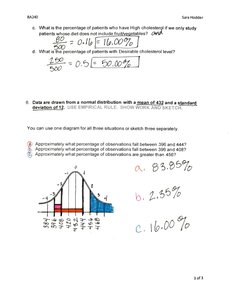
Q7. What is the percentage of patients who did not have flu symptoms and have High cholesterol?
Background
Topic: Contingency Tables
This question tests your ability to interpret and calculate probabilities from a contingency table.
Key Terms and Formulas:
Contingency table: A table showing the frequency of combinations of two categorical variables.
Percentage calculation:
Step-by-Step Guidance
Locate the cell in the table for patients with High cholesterol and no flu symptoms.
Find the total number of patients.
Set up the percentage calculation formula.
Pause before computing the final percentage.
Try solving on your own before revealing the answer!
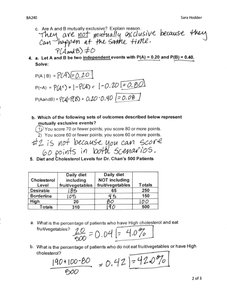
Q8. What is the percentage of patients who have High cholesterol if only study patients whose diet does not include fruit/vegetables?
Background
Topic: Conditional Probability from Contingency Tables
This question tests your ability to calculate conditional probabilities using a contingency table.
Key Terms and Formulas:
Conditional probability:
Percentage calculation:
Step-by-Step Guidance
Find the number of patients with High cholesterol and no fruit/vegetables.
Find the total number of patients with no fruit/vegetables.
Set up the percentage calculation formula.
Pause before computing the final percentage.
Try solving on your own before revealing the answer!
Q9. What is the percentage of patients with Desirable cholesterol levels?
Background
Topic: Contingency Tables
This question tests your ability to calculate the proportion of patients with a specific characteristic from a contingency table.
Key Terms and Formulas:
Percentage calculation:
Step-by-Step Guidance
Find the number of patients with Desirable cholesterol levels in the table.
Find the total number of patients.
Set up the percentage calculation formula.
Pause before computing the final percentage.
Try solving on your own before revealing the answer!
Q10. Data are drawn from a normal distribution with a mean of 432 and a standard deviation of 37. Use the empirical rule to answer:
Background
Topic: Normal Distribution & Empirical Rule
This question tests your understanding of the empirical rule (68-95-99.7 rule) for normal distributions.
Key Terms and Formulas:
Normal distribution: Bell-shaped curve, symmetric about the mean.
Empirical rule: About 68% of values fall within 1 SD, 95% within 2 SD, 99.7% within 3 SD.
Standard deviation (SD): Measure of spread.
Step-by-Step Guidance
Calculate the intervals for 1, 2, and 3 standard deviations from the mean: .
Use the empirical rule to estimate the percentage of observations within each interval.
Match the intervals to the questions asked (e.g., between 395 and 447).
Pause before stating the final percentages.
Try solving on your own before revealing the answer!