 Back
BackProbability and Random Variables: Step-by-Step Guidance
Study Guide - Smart Notes
 Tailored notes based on your materials, expanded with key definitions, examples, and context.
Q1. Poker Chips: What is the probability that a randomly selected poker chip is (a) red, (b) red or white, (c) not white?
Background
Topic: Basic Probability
This question tests your understanding of calculating probabilities for simple events and compound events using the classical definition of probability.
Key Terms and Formulas
Probability of an event :
Complement: The probability that an event does not occur is
Mutually Exclusive: Events that cannot happen at the same time.
Step-by-Step Guidance
Identify the total number of poker chips in the bowl: 3 red, 4 white, 5 blue. Add these to get the total.
For part (a), count the number of red chips and use the probability formula to set up .
For part (b), add the number of red and white chips, then use the probability formula for .
For part (c), count the chips that are not white (red and blue), then use the probability formula for .
Try solving on your own before revealing the answer!
Final Answer:
a.
b.
c.
Each probability is calculated by dividing the number of chips of the relevant color(s) by the total number of chips.
Q2. Dice: Two balanced dice are rolled. What is the probability that the sum of the dice is (a) 6, (b) even, (c) 7 or 11, (d) 2, 3, or 12?
Background
Topic: Probability with Multiple Outcomes
This question tests your ability to enumerate outcomes and calculate probabilities for compound events using the sample space of rolling two dice.
Key Terms and Formulas
Sample space for two dice: 36 possible outcomes (6 sides × 6 sides)
Probability of an event :
Step-by-Step Guidance
Use the sample space diagram (see below) to count the number of outcomes for each event.
For part (a), count the pairs that sum to 6.
For part (b), count the pairs that sum to an even number (2, 4, 6, 8, 10, 12).
For part (c), count the pairs that sum to 7 or 11.
For part (d), count the pairs that sum to 2, 3, or 12.
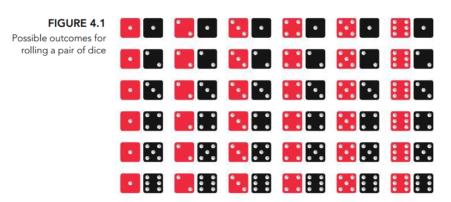
Try solving on your own before revealing the answer!
Final Answer:
a.
b.
c.
d.
Each probability is calculated by counting the relevant pairs in the sample space.
Q3. Russian Presidential Election: What is the probability that a randomly selected voter voted for (a) Putin, (b) either Zhirinovsky or Mironov, (c) someone other than Putin?
Background
Topic: Probability from Frequency Data
This question tests your ability to calculate probabilities using frequency distributions from real-world data.
Key Terms and Formulas
Probability of an event :
Step-by-Step Guidance
Add up the total number of votes for all candidates to get the denominator.
For part (a), use the number of votes for Putin as the numerator.
For part (b), add the votes for Zhirinovsky and Mironov for the numerator.
For part (c), subtract Putin's votes from the total to get the numerator.
Try solving on your own before revealing the answer!
Final Answer:
a.
b.
c.
Each probability is calculated using the frequency of votes for the relevant candidates.
Q4. Dice: List the outcomes constituting each event for a single die roll.
Background
Topic: Sample Space and Events
This question tests your ability to identify outcomes in the sample space that correspond to specific events.
Key Terms
Sample space: All possible outcomes (1, 2, 3, 4, 5, 6)
Event: A subset of the sample space
Step-by-Step Guidance
List the sample space for a single die roll: {1, 2, 3, 4, 5, 6}
For event A (even), identify which numbers are even.
For event B (4 or more), identify which numbers are 4, 5, or 6.
For event C (at most 2), identify which numbers are 1 or 2.
For event D (comes up 3), identify which number is 3.
Try solving on your own before revealing the answer!
Final Answer:
A: {2, 4, 6}
B: {4, 5, 6}
C: {1, 2}
D: {3}
Each event is a subset of the sample space based on the description.
