 Back
BackProbability and Sample Spaces: Study Notes for Statistics Chapter 4.1
Study Guide - Smart Notes
 Tailored notes based on your materials, expanded with key definitions, examples, and context.
Probability and Sample Spaces
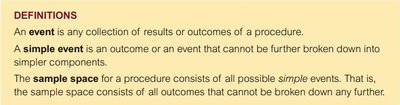
Definitions: Events, Simple Events, and Sample Space
Understanding the basic terminology of probability is essential for analyzing random experiments and their outcomes. The concepts of event, simple event, and sample space form the foundation of probability theory.
Event: Any collection of results or outcomes of a procedure.
Simple Event: An outcome or event that cannot be further broken down into simpler components.
Sample Space: The set of all possible simple events for a procedure; it includes all outcomes that cannot be broken down any further.
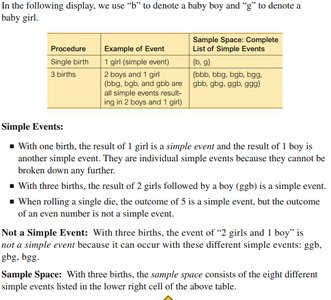
Examples of Simple Events and Sample Spaces
Examples help clarify the distinction between simple events and more complex events, as well as how to enumerate the sample space for a given procedure.
For a single birth, the result of a boy (b) or girl (g) is a simple event.
For three births, the sample space consists of all possible sequences of boys and girls, such as bbb, bbg, bgb, etc.
Not all events are simple; for example, "2 girls and 1 boy" is not a simple event because it can occur in multiple ways.
Sample Space Table: For three births, the sample space includes eight simple events:
Procedure | Example of Event | Sample Space: Complete List of Simple Events |
|---|---|---|
Single birth | 1 girl (simple event) | g, b |
3 births | 2 boys and 1 girl (bbg, bgb, gbb are all simple events resulting in 2 boys and 1 girl) | bbb, bbg, bgb, bgg, gbb, gbg, ggb, ggg |
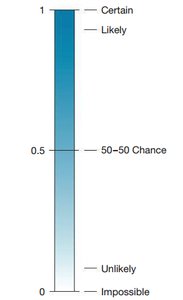
Expressing Probability: Likelihood Scale
Probability values are expressed on a scale from 0 to 1, where 0 represents impossibility and 1 represents certainty. Intermediate values indicate varying degrees of likelihood.
0: Impossible event
0.5: 50-50 chance
1: Certain event
Values between 0 and 1 indicate how likely an event is to occur.
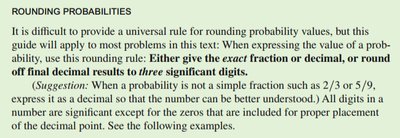
Rounding Probabilities
When expressing probability values, it is important to use consistent rounding rules for clarity and precision. Probabilities should be given as exact fractions or decimals, or rounded to three significant digits.
Express probabilities as exact fractions or decimals.
Round final decimal results to three significant digits.
All digits in a number are significant except for zeros used for proper placement of the decimal point.
Tree Diagrams and Sample Spaces
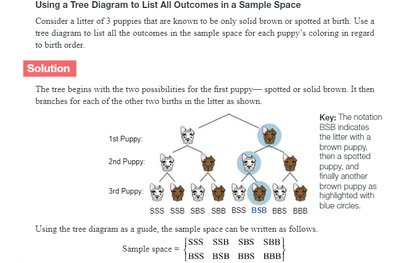
Tree diagrams are useful for visualizing all possible outcomes in multi-stage experiments. Each branch represents a possible outcome at each stage, helping to systematically enumerate the sample space.
Tree diagrams begin with the outcomes of the first stage and branch out for each subsequent stage.
They are especially helpful for experiments with several stages, such as determining the possible gender sequences of four children or the colorings of puppies.
Example: For a litter of three puppies, each can be solid brown or spotted. The tree diagram shows all possible outcomes:
Sample Space for 3 Puppies |
|---|
SSS, SSB, SBS, SBB, BSS, BSB, BBS, BBB |
Probability Example: Thanksgiving Day
Probability can be applied to real-world scenarios, such as determining the likelihood of Thanksgiving Day falling on a particular day of the week.
To find the probability that Thanksgiving Day falls on a Wednesday or Thursday, enumerate the possible days and calculate the probability accordingly.

Odds and Payoff Odds
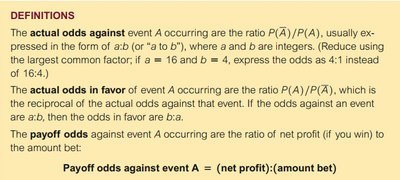
Odds are another way to express the likelihood of events, often used in gambling and games of chance. There are several types of odds:
Actual odds against: The ratio , usually expressed as a:b.
Actual odds in favor: The reciprocal of the actual odds against.
Payoff odds: The ratio of net profit (if you win) to the amount bet.
Formula:
Odds Example: Roulette
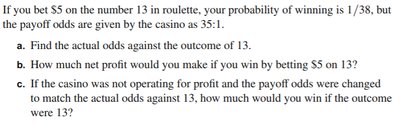
Consider a roulette bet where the probability of winning is , but the casino offers payoff odds of 35:1. Calculating actual odds, net profit, and fair payoff odds illustrates the difference between probability and betting odds.
Actual odds against: (since there are 37 losing outcomes and 1 winning outcome).
Net profit: If you win by betting $5, your net profit is $5 \times 35 = $175.
Fair payoff odds: If the casino matched actual odds, the payoff would be $5 \times 37 = $185.
Summary Table: Key Probability Concepts
Concept | Definition | Example |
|---|---|---|
Event | Collection of outcomes | Rolling a 5 on a die |
Simple Event | Cannot be broken down further | Getting a boy in a single birth |
Sample Space | All possible simple events | {bbb, bbg, bgb, bgg, gbb, gbg, ggb, ggg} |
Probability | Likelihood of an event (0 to 1) | 0.5 for flipping heads on a fair coin |
Odds | Ratio of probabilities | 37:1 against winning roulette |
