 Back
BackProbability Concepts – Study Notes
Study Guide - Smart Notes
 Tailored notes based on your materials, expanded with key definitions, examples, and context.
Chapter 4: Probability Concepts
Section 4.1: Probability Basics
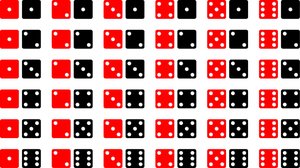
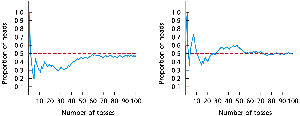
Probability is a measure of how likely an event is to occur, expressed as a number between 0 and 1. In experiments with equally likely outcomes, probability quantifies the chance of a specific event occurring.
Probability for Equally Likely Outcomes: If an experiment has N equally likely outcomes and an event can occur in f ways, the probability of the event is:
Basic Properties of Probabilities:
The probability of any event is between 0 and 1, inclusive.
The probability of an impossible event is 0.
The probability of a certain event is 1.
Section 4.2: Events
Events are subsets of the sample space, which is the set of all possible outcomes of an experiment.
Sample Space (S): The collection of all possible outcomes.
Event (E): Any subset of the sample space. An event occurs if the outcome is in E.
Relationships Among Events:
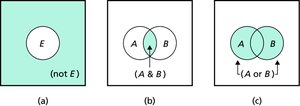
Not E: The event "E does not occur" (complement of E).
A & B: The event "both A and B occur" (intersection).
A or B: The event "either A or B or both occur" (union).
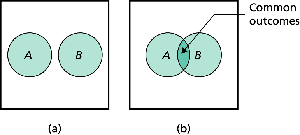
Mutually Exclusive Events: Two or more events are mutually exclusive if they have no outcomes in common.
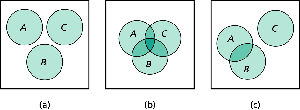
Section 4.3: Some Rules of Probability
Probability rules help calculate the likelihood of combined events.
Probability Notation: denotes the probability that event E occurs.
Special Addition Rule: For mutually exclusive events A and B:
For mutually exclusive events :
Complementation Rule: For any event E:
General Addition Rule: For any events A and B:
Section 4.4: Contingency Tables; Joint and Marginal Probabilities
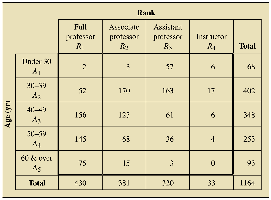
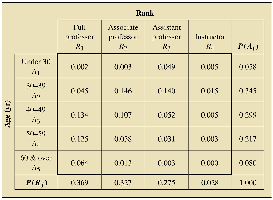
Contingency tables organize data to show the frequency or probability of combinations of two or more categorical variables. Joint probabilities refer to the probability of two events occurring together, while marginal probabilities refer to the probability of a single event irrespective of the other.
Contingency Table for Age and Rank of Faculty Members |
|---|
Joint Probability Distribution Corresponding to Table 4-6 |
|---|
Section 4.5: Conditional Probability
Conditional probability measures the probability of an event occurring given that another event has already occurred.
Conditional Probability Notation: is the probability of B given A.
Conditional Probability Rule: If :
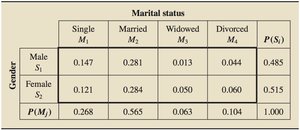
Joint Probability Distribution of Marital Status and Gender |
|---|
Section 4.6: The Multiplication Rule; Independence
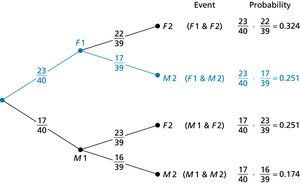
The multiplication rule is used to find the probability that two events both occur. Events are independent if the occurrence of one does not affect the probability of the other.
General Multiplication Rule: For any events A and B:
Independent Events: Event B is independent of event A if .
Special Multiplication Rule (for Independent Events):
For independent events :
Section 4.7: Bayes’s Rule
Bayes’s Rule allows us to update probabilities based on new information. The rule of total probability helps calculate the probability of an event by considering all possible ways it can occur.
Rule of Total Probability: If are mutually exclusive and exhaustive events, then for any event B:
Bayes’s Rule: For mutually exclusive and exhaustive events and any event B:
Section 4.8: Counting Rules
Counting rules help determine the number of ways events can occur, which is essential for calculating probabilities in complex experiments.
Basic Counting Rule (BCR): If r actions are performed in order, with possibilities for the first, for the second, ..., for the r-th, then the total number of possibilities is .
Factorials: ; by definition, .
Permutations: The number of ways to arrange r objects from m is:
Special Permutations Rule: The number of ways to arrange m objects among themselves is .
Combinations: The number of ways to choose r objects from m (order does not matter):
Number of Possible Samples: The number of possible samples of size n from a population of size N is:
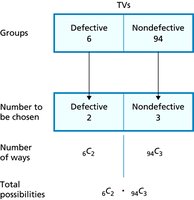
Example: If you have 5 letters and want to know how many ways you can arrange 3 of them, use the permutation formula. If you want to know how many ways you can choose 3 letters (order does not matter), use the combination formula.
Additional info: These rules are foundational for probability calculations in statistics, especially in experiments involving selection, arrangement, or grouping of objects.
