 Back
BackRandom Variables and Probability Models – Study Notes
Study Guide - Smart Notes
 Tailored notes based on your materials, expanded with key definitions, examples, and context.
Random Variables and Probability Models
Introduction
This chapter explores the concept of random variables, their probability models, and the calculation of expected values and variances. It also introduces important discrete probability models, including the Uniform, Geometric, Binomial, and Poisson distributions, which are foundational for statistical inference and modeling real-world random phenomena.
Random Variables
Types of Random Variables
Random Variable: A variable whose value is determined by the outcome of a random event.
Discrete Random Variable: Can take on a countable number of distinct values (e.g., number of books purchased).
Continuous Random Variable: Can take on any value within a given interval (e.g., time, weight).
The probability model for a random variable lists all possible values and their associated probabilities.
Expected Value of a Random Variable
Definition and Calculation
The expected value (mean) of a discrete random variable is the long-run average value it takes after many repetitions of the random process. It is calculated as:
where are the possible values and are their probabilities.
Example: Life Insurance Policy
The probability model for a life insurance policy is shown below:
Policyholder Outcome | Payout x (cost) | Probability |
|---|---|---|
Death | 100,000 | 1/1000 |
Disability | 50,000 | 2/1000 |
Neither | 0 | 997/1000 |
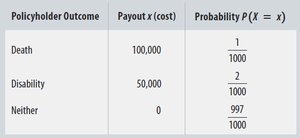
The expected annual payout is calculated as:
Standard Deviation and Variance of a Random Variable
Definition and Calculation
The variance of a discrete random variable measures the average squared deviation from the mean:
The standard deviation is the square root of the variance:
Example: Life Insurance Policy (Standard Deviation)
Policyholder Outcome | Payout (cost) | Probability | Deviation |
|---|---|---|---|
Death | 100,000 | 1/1000 | 99,800 |
Disability | 50,000 | 2/1000 | 49,800 |
Neither | 0 | 997/1000 | -200 |
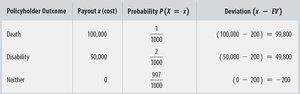
Example: Book Store Purchases
Probabilities: 0 books (0.2), 1 book (0.4), 2 books (0.4)
Expected value:
Standard deviation:
Properties of Expected Values and Variances
Linear Transformations
Adding a constant to :
Multiplying by a constant :
Addition Rule for Random Variables
For independent random variables and :
Bernoulli Trials
Definition and Properties
Each trial has two outcomes: success (probability ) and failure (probability ).
Trials are independent.
10% Condition: If the sample size is less than 10% of the population, independence can be assumed.
Examples: Coin tosses, yes/no survey responses, basketball free throws.
Discrete Probability Models
Uniform Model
If has possible outcomes, each equally likely, then has a Uniform distribution .
Example: Tossing a fair die (), each outcome has probability .
Geometric Model
Predicts the number of Bernoulli trials required to achieve the first success.
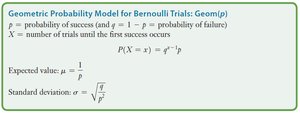
Probability:
Expected value:
Standard deviation:
Example: Probability that a salesman closes his first sale on the fourth attempt (with ): Use the geometric model.
Binomial Model
Predicts the number of successes in a fixed number of Bernoulli trials.
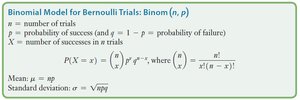
Probability:
Mean:
Standard deviation:
Example: Probability that a tennis player makes all 6 first serves in bounds (, ): Use the binomial model.
Expected number in bounds:
Poisson Model
Predicts the number of events that occur over a given interval of time or space. Used for modeling counts of occurrences.
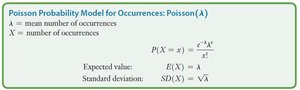
Probability:
Expected value:
Standard deviation:
Example: Number of website purchases per minute (mean rate ): Use the Poisson model.
Uniform Model Example: Satisfaction Survey
Probability model: Uniform (all numbers equally likely).
Probability selected number is even:
Probability selected number ends in 000:
Key Points and Cautions
Probability models are simplifications; if the model is wrong, so are the results.
Check for independence when using models that require it (e.g., Bernoulli trials).
Variances of independent random variables add, but standard deviations do not.
For discrete random variables, probability models assign a probability to each possible outcome.
Summary of Formulas
Expected value (mean):
Variance:
Standard deviation:
Linear transformations:
Addition of independent random variables:
Distributions Covered
Uniform: All outcomes equally likely.
Geometric: Number of trials until first success.
Binomial: Number of successes in fixed number of trials.
Poisson: Number of events in a fixed interval.
