Back
BackStatistics Course Sequence and Topics Overview
Study Guide - Smart Notes
 Tailored notes based on your materials, expanded with key definitions, examples, and context.
Course Sequence and Topics Overview
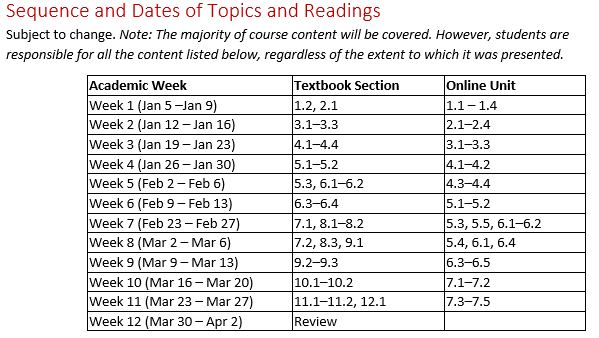
This syllabus outlines the sequence of topics and readings for a college-level statistics course. The schedule is organized by academic week, textbook sections, and corresponding online units. Students are responsible for all listed content, regardless of the extent to which it was presented in class.
Weekly Topics and Readings
The following table summarizes the weekly progression of topics, aligning textbook sections with online units. This structure ensures comprehensive coverage of foundational and advanced statistics concepts.
Academic Week | Textbook Section | Online Unit |
|---|---|---|
Week 1 (Jan 5 – Jan 9) | 1.2, 2.1 | 1.1 – 1.4 |
Week 2 (Jan 12 – Jan 16) | 3.1 – 3.3 | 2.1 – 2.4 |
Week 3 (Jan 19 – Jan 23) | 4.1 – 4.4 | 3.1 – 3.3 |
Week 4 (Jan 26 – Jan 30) | 5.1 – 5.2 | 4.1 – 4.2 |
Week 5 (Feb 2 – Feb 6) | 5.3, 6.1 – 6.2 | 4.3 – 4.4 |
Week 6 (Feb 9 – Feb 13) | 6.3 – 6.4 | 5.1 – 5.2 |
Week 7 (Feb 23 – Feb 27) | 7.1, 8.1 – 8.2 | 5.3, 5.5, 6.1 – 6.2 |
Week 8 (Mar 2 – Mar 6) | 7.2, 8.3, 9.1 | 5.4, 6.1, 6.4 |
Week 9 (Mar 9 – Mar 13) | 9.2 – 9.3 | 6.3 – 6.5 |
Week 10 (Mar 16 – Mar 20) | 10.1 – 10.2 | 7.1 – 7.2 |
Week 11 (Mar 23 – Mar 27) | 11.1 – 11.2, 12.1 | 7.3 – 7.5 |
Week 12 (Mar 30 – Apr 2) | Review |
Key Statistics Topics Covered
Introduction to Statistics: Understanding the basics and scope of statistics.
Exploring Data with Tables and Graphs: Visual and tabular data representation.
Describing, Exploring, and Comparing Data: Measures of central tendency, variability, and comparison.
Probability: Fundamental probability concepts and calculations.
Discrete Probability Distributions: Binomial, Poisson, and other discrete distributions.
Normal Probability Distributions: Properties and applications of the normal distribution.
Estimating Parameters and Determining Sample Sizes: Confidence intervals and sample size determination.
Hypothesis Testing: Steps and methods for statistical hypothesis testing.
Inferences from Two Samples: Comparing two populations or samples.
Correlation and Regression: Relationships between variables and predictive modeling.
Goodness-of-Fit and Contingency Tables: Chi-square tests and categorical data analysis.
Analysis of Variance (ANOVA): Comparing means across multiple groups.
Study Recommendations
Review each week's assigned textbook sections and online units thoroughly.
Focus on understanding key concepts, formulas, and their applications.
Practice with examples and exercises to reinforce learning.
Utilize review week to consolidate knowledge and address any gaps.