 Back
BackStatistics Study Guide: Measures of Central Tendency, Probability, and Data Interpretation
Study Guide - Smart Notes
 Tailored notes based on your materials, expanded with key definitions, examples, and context.
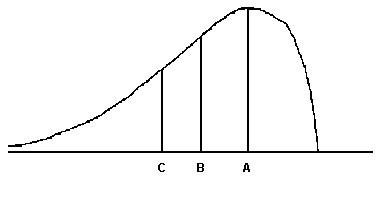
Q4. For the distribution drawn here, identify the mean, median, and mode.
Background
Topic: Measures of Central Tendency in Skewed Distributions
This question tests your understanding of how the mean, median, and mode are positioned in a skewed distribution. The image shows a right-skewed (positively skewed) distribution with three labeled points: A, B, and C.
Key Terms:
Mean: The arithmetic average of all values in the data set.
Median: The middle value when the data are ordered from least to greatest.
Mode: The value that occurs most frequently in the data set.
Right-skewed distribution: A distribution where the tail on the right side is longer or fatter than the left side.
Step-by-Step Guidance
Recall that in a right-skewed distribution, the mode is typically the highest point (the peak), the median is to the right of the mode, and the mean is further to the right due to the influence of higher values in the tail.
Identify which labeled line (A, B, or C) corresponds to the peak of the distribution. This will be the mode.
Determine which line is in the middle position; this will be the median.
The line furthest to the right will represent the mean, as it is pulled in the direction of the skew.
Try solving on your own before revealing the answer!
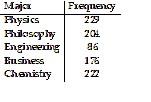
Q28. What is the probability that a randomly selected student with a Bachelor's degree majored in Physics or Philosophy?
Background
Topic: Probability Using Frequency Tables
This question asks you to calculate the probability that a randomly selected student majored in either Physics or Philosophy, using the provided frequency table.
Key Terms and Formula:
Probability: The likelihood of an event occurring, calculated as the number of favorable outcomes divided by the total number of outcomes.
Addition Rule for Disjoint Events: If two events cannot both occur, the probability that either occurs is the sum of their probabilities.
Key formula:
Where and are mutually exclusive events (here, majoring in Physics or Philosophy).
Step-by-Step Guidance
Find the frequency (number of students) for Physics and Philosophy from the table.
Add these two frequencies together to get the total number of students who majored in Physics or Philosophy.
Find the total number of students by adding all the frequencies in the table.
Set up the probability as the number of students who majored in Physics or Philosophy divided by the total number of students.
Try solving on your own before revealing the answer!
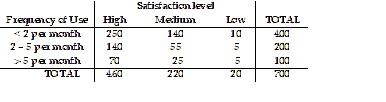
Q29. What is the probability that a respondent did not have a low level of satisfaction with the company?
Background
Topic: Probability Using Two-Way Tables and the Complement Rule
This question asks you to use a two-way table to find the probability that a randomly selected respondent did not have a low satisfaction level.
Key Terms and Formula:
Complement Rule: The probability that event does not occur is .
Two-way table: A table that shows the frequency of combinations of two categorical variables.
Key formula:
Step-by-Step Guidance
Find the total number of respondents (sum of all entries in the table or use the grand total if provided).
Find the total number of respondents with a low satisfaction level (sum the 'Low' column).
Calculate the probability of a respondent having a low satisfaction level: .
Use the complement rule to find the probability that a respondent did not have a low satisfaction level: .
Try solving on your own before revealing the answer!
