 Back
BackStudy Guide: Normal Probability Distributions in Statistics
Study Guide - Smart Notes
 Tailored notes based on your materials, expanded with key definitions, examples, and context.
Normal Probability Distributions
Introduction to the Normal Distribution
The normal distribution is a fundamental concept in statistics, describing a continuous probability distribution that is symmetric and bell-shaped. It is widely used in the health sciences and other fields to model real-world phenomena.
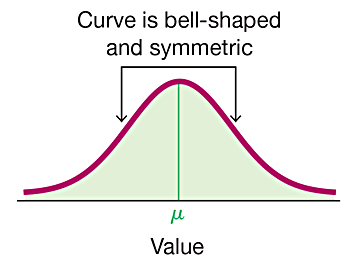
Definition: A continuous random variable has a normal distribution if its graph is symmetric and bell-shaped.
Key Properties: The mean, median, and mode are all equal; the curve is symmetric about the mean; and the total area under the curve is 1.
Density Curve: The graph of any continuous probability distribution is called a density curve, and the area under the curve represents probability.
The Standard Normal Distribution
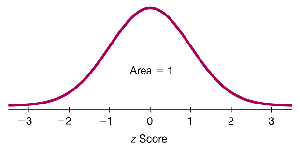
The standard normal distribution is a special case of the normal distribution with a mean of 0 and a standard deviation of 1. It is used to calculate probabilities and z scores for various regions under the curve.
Notation: The variable z represents the number of standard deviations a value is from the mean.
Area and Probability: The area under the curve corresponds to probability, and the total area is 1.
Finding Probabilities Using z Scores
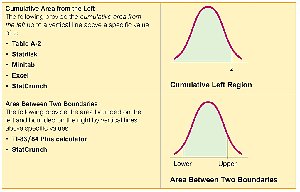
Probabilities for the normal distribution are found by calculating the area under the curve for a given z score. This can be done using statistical tables or technology.
Left of z: Probability that a value is less than a given z score.
Right of z: Probability that a value is greater than a given z score.
Between z values: Probability that a value falls between two z scores.
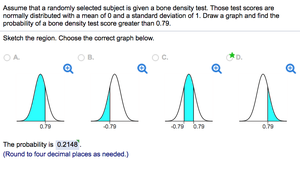
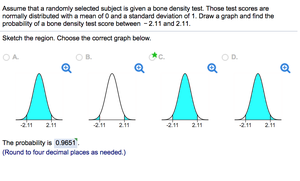
Examples: Bone Density Test
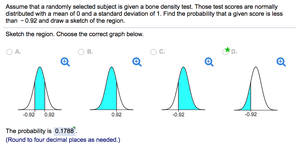
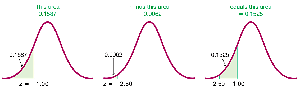
Bone density test scores are often modeled using the standard normal distribution. The probability of a score less than or greater than a certain value can be found using z scores and area under the curve.
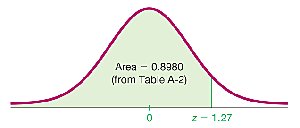
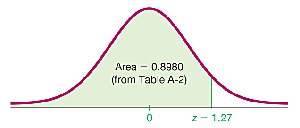
Example: Probability that a bone density test score is less than 1.27.
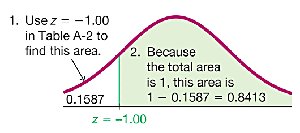
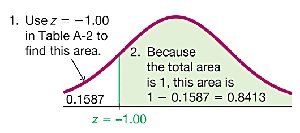
Example: Probability that a score is above -1.00.
Example: Probability that a score is between -1.00 and -2.50.
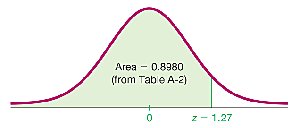
Notation and Critical Values
Statistical notation is used to represent probabilities and critical values in the normal distribution.
P(a < z < b): Probability that z is between a and b.
P(z > a): Probability that z is greater than a.
P(z < a): Probability that z is less than a.
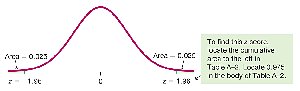
Critical Value: A z score on the borderline separating significantly low or high values. Notation: zα denotes the z score with an area of α to its right.
Converting Nonstandard Normal Distributions
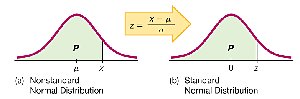
When the mean and standard deviation are not 0 and 1, values can be converted to z scores using the formula:
Conversion Formula:
Application: Allows any normal distribution to be standardized for probability calculations.
Example: Heights of Men and Showerhead Design
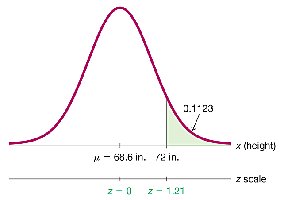
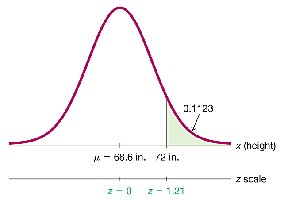
Heights of men are normally distributed. To find the proportion taller than a certain height, convert the value to a z score and find the area to the right.
Given: Mean = 68.6 in., σ = 2.8 in., height = 72 in.
Step 1: Convert 72 in. to z score:
Step 2: Find area to the right of z = 1.21.
Result: About 11% of men are taller than 72 in.

Finding Values from Known Areas
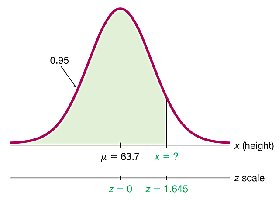
When the area (probability or percentage) is known, the corresponding value can be found using the z score and conversion formula.
Procedure: Sketch the curve, identify the region, use Table A-2 or technology to find the z score, then convert to x using .
Percentiles: The value corresponding to a given percentile can be found using the same method.
Sampling Distributions and Estimators
A sampling distribution is the distribution of a statistic (such as sample mean or proportion) when all possible samples of a given size are taken from a population.
Sample Proportions: Tend to be normally distributed; mean equals the population mean.
Unbiased Estimators: Statistics that target the population parameter (mean, proportion, variance).
Biased Estimators: Statistics that do not target the population parameter (median, range, sample standard deviation).
The Central Limit Theorem
The central limit theorem states that the distribution of sample means approaches a normal distribution as the sample size increases, regardless of the population's distribution, provided n > 30 or the population is normal.
Application: Allows use of normal distribution for inference about sample means.
Notation: ,
Example: Safe Loading of Elevators
To assess elevator safety, calculate the probability that the mean weight of 27 randomly selected males exceeds a threshold using the normal distribution and central limit theorem.
Step 1: Convert individual weight to z score.
Step 2: For sample mean, use .
Result: Probability of exceeding weight threshold is extremely high, indicating risk.
Assessing Normality
To determine if data are from a normal distribution, use visual inspection, outlier identification, and normal quantile plots.
Histogram: Should be bell-shaped and symmetric.
Outliers: More than one outlier suggests non-normality.
Normal Quantile Plot: Points should lie close to a straight line without systematic patterns.
Summary Table: Key Formulas and Concepts
Concept | Formula | Application |
|---|---|---|
Standard Normal z Score | Convert any value to standard normal | |
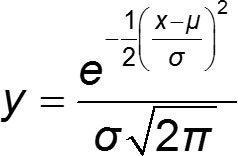
Normal Distribution PDF | Probability density function | |
Sample Mean Distribution | , | Central Limit Theorem |
Additional info:
All examples and images are directly relevant to the explanation of normal probability distributions, z scores, and their applications in statistics.
Critical values and percentiles are important for hypothesis testing and statistical inference.
Assessing normality is essential for determining the appropriateness of statistical methods.
