Ch. 1 - Introduction to Statistics
Larson - Elementary Statistics: Picturing the World 8th Edition
Larson8th EditionElementary Statistics: Picturing the WorldISBN: 9780137493470Not the one you use?Change textbook
Chapter 1, Problem 1.T.4a

Determine whether the data are qualitative or quantitative, and determine the level of measurement of the data set. Explain your reasoning.
The numbers of employees at fast-food restaurants in a city are listed.
20 11 6 31 17 23 12 18 40 22 13 8 18 14 37 32 25 27 25 18

Verified step by step guidance
1
Step 1: Understand the type of data. The data provided represents the 'numbers of employees' at fast-food restaurants. Since these are numerical values that can be counted, the data is quantitative (not qualitative, which would involve categories or labels).
Step 2: Determine the level of measurement. Quantitative data can be either interval or ratio. To decide, consider whether the data has a true zero point. In this case, a value of 0 employees would mean no employees, which is a true zero. Therefore, the data is at the ratio level of measurement.
Step 3: Explain the reasoning for the ratio level. Ratio data allows for meaningful comparisons using multiplication or division. For example, a restaurant with 20 employees has twice as many employees as one with 10 employees, which is a valid interpretation.
Step 4: Summarize the findings. The data is quantitative because it consists of numerical counts, and it is at the ratio level because it has a true zero point and supports meaningful ratios.
Step 5: Note the importance of context. Always consider the context of the data when determining its type and level of measurement, as this ensures accurate classification and interpretation.

Verified video answer for a similar problem:

This video solution was recommended by our tutors as helpful for the problem above.
Video duration:
3m
Was this helpful?

Key Concepts

Here are the essential concepts you must grasp in order to answer the question correctly.

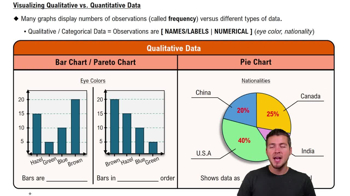
Qualitative vs. Quantitative Data

Qualitative data refers to non-numerical information that describes characteristics or qualities, such as names or categories. In contrast, quantitative data consists of numerical values that can be measured or counted, allowing for mathematical operations. In the given question, the numbers of employees represent quantitative data since they are counts of individuals.
Recommended video:
Guided course
04:39
Visualizing Qualitative vs. Quantitative Data

Levels of Measurement

Levels of measurement categorize data based on the nature of the information they represent. The four primary levels are nominal, ordinal, interval, and ratio. The data set in the question, which consists of counts of employees, is at the ratio level because it has a true zero point (zero employees) and allows for meaningful comparisons and calculations.
Recommended video:
Guided course
10:28
Difference in Proportions: Hypothesis Tests Example 1

Descriptive Statistics

Descriptive statistics summarize and describe the main features of a data set, providing insights into its central tendency, variability, and distribution. In analyzing the number of employees, one might calculate measures such as the mean, median, or mode to better understand the data's characteristics, which can aid in interpreting the results and making informed decisions.
Recommended video:
Guided course
05:53
Parameters vs. Statistics
Related Practice
Textbook Question

Determine whether each number describes a population parameter or a sample statistic. Explain.

In a recent year, the average evidence-based reading and writing score on the SAT was 528. (Source: College Board)

269
views

Textbook Question

A company wants to test the effectiveness of a new acne cream. The company recruits 500 girls ages 13 to 17 who have acne. The subjects are randomly assigned into two groups. One group is given the acne cream and the other is given a placebo that looks exactly like the acne cream. Both groups apply the cream daily for two months. Facial photos are taken at the beginning and end of the treatment to compare results.

Identify the experimental units and treatments used in this experiment.

180
views
Textbook Question

Determine whether the survey question is biased. If the question is biased, suggest a better wording.

Do you agree that the town’s ban on skateboarding in parks is unfair?

214
views
Textbook Question

Researchers in Japan tested the effect of cannabidiol (CBD) in treating late teenagers with social anxiety disorder (SAD). Thirty-seven 18- to 19-year-old teenagers with SAD took part in the study. The patients were assigned at random to receive a daily dose of either CBD or a placebo for 4 weeks. Symptoms were measured using The Fear of Negative Evaluation Questionnaire and the Liebowitz Social Anxiety Scale at the beginning and end of the treatment. (Source: Frontiers in Psychology)

a. Identify the experimental units and treatments used in this experiment.

124
views
Textbook Question

Determine whether the survey question is biased. If the question is biased, suggest a better wording.

How many hours of sleep do you get on a normal night?

112
views
Textbook Question

Identify the sampling technique used, and discuss potential sources of bias (if any). Explain.

Questioning teachers as they leave a faculty lounge, a researcher asks 45 of them about their teaching styles.

198
views