Ch. 3 - Probability
Larson - Elementary Statistics: Picturing the World 8th Edition
Larson8th EditionElementary Statistics: Picturing the WorldISBN: 9780137493470Not the one you use?Change textbook
Chapter 3, Problem 3.4.20

20. Skating Eight people compete in a short track speed skating race. Assuming that there are no ties, in how many different orders can the skaters finish?

Verified step by step guidance
1
Step 1: Recognize that this problem involves permutations, as the order in which the skaters finish matters.
Step 2: Recall the formula for permutations of n distinct items, which is n!. This represents the total number of ways to arrange n items in order.
Step 3: Identify the number of skaters competing in the race, which is 8. Therefore, we need to calculate 8! (8 factorial).
Step 4: Write out the factorial expression for 8!: 8! = 8 × 7 × 6 × 5 × 4 × 3 × 2 × 1.
Step 5: Multiply the terms in the factorial expression to determine the total number of permutations. This will give the number of different orders in which the skaters can finish.

Verified video answer for a similar problem:

This video solution was recommended by our tutors as helpful for the problem above.
Video duration:
1m
Was this helpful?

Key Concepts

Here are the essential concepts you must grasp in order to answer the question correctly.

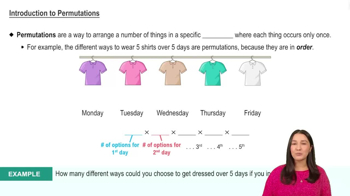
Permutations

Permutations refer to the different ways in which a set of items can be arranged or ordered. In this context, the eight skaters can finish in various sequences, and the total number of unique arrangements is calculated using the factorial of the number of items, denoted as n!. For example, if there are 3 skaters, the number of finishing orders would be 3! = 6.
Recommended video:
07:11
Introduction to Permutations

Factorial

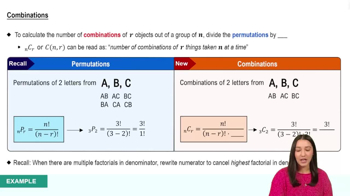
The factorial of a non-negative integer n, denoted as n!, is the product of all positive integers up to n. It is a fundamental concept in combinatorics used to determine the number of ways to arrange n distinct objects. For instance, 5! = 5 × 4 × 3 × 2 × 1 = 120, which represents the number of ways to arrange 5 skaters.
Recommended video:
05:22
Combinations

Combinatorial Counting

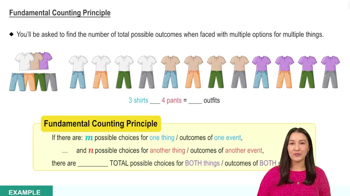
Combinatorial counting involves techniques for counting the arrangements or selections of items in a set. In the case of the skating race, since the order of finish matters and there are no ties, we use permutations to count the possible outcomes. Understanding this concept is crucial for solving problems related to arrangements and sequences in statistics.
Recommended video:
04:04
Fundamental Counting Principle
Related Practice
Textbook Question

Boy or Girl? In Exercises 71-74, a couple plans to have three children. Each child is equally likely to be a boy or a girl.

71. What is the probability that all three children are girls?

98
views

Textbook Question

"Classifying Events Based on Studies In Exercises 15-18, identify the two events described in the study. Do the results indicate that the events are independent or dependent? Explain your reasoning.

16. A study found no significant association between the use of talc powder and the incidence of ovarian cancer in women. (Source: JAMA)"

39
views
Textbook Question

According to Bayes’ Theorem, the probability of event A , given that event B has occurred, is

P(A|B) = P(A) * P(B|A)P(A) * P(B|A) + P(A') * P(B|A').

In Exercises 33–38, use Bayes’ Theorem to find P(A|B).

37. P(A) = 73%, P(A') = 17%, P(B|A) = 46% , and P(B|A') = 52%

108
views
Textbook Question

97. Rolling a Pair of Dice You roll a pair of six-sided dice and record the sum.

a. List all of the possible sums and determine the probability of rolling each sum.

b. Use technology to simulate rolling a pair of dice and record the sum 100 times. Make a tally of the 100 sums and use these results to list the probability of rolling

each sum.

c. Compare the probabilities in part (a) with the probabilities in part (b). Explain any similarities or differences.

143
views
Textbook Question

Finding New Music In Exercises 45–48, use the pie chart, which shows the results of a survey of 513 music listeners who were asked about their primary source for new music. (Source: The Sound of AI)

<IMAGE>

47. You choose nine music listeners at random. What is the probability that none of them say their primary source for new music is friends or social media?

70
views
Textbook Question

Using the Fundamental Counting Principle In Exercises 37-40, use the Fundamental Counting Principle.

40. True or False Quiz Assuming that no questions are left unanswered, in how many ways can a six-question true or false quiz be answered?

165
views