
Ch. 3 - Probability
Larson - Elementary Statistics: Picturing the World 8th Edition
Larson8th EditionElementary Statistics: Picturing the WorldISBN: 9780137493470Not the one you use?Change textbook
Chapter 3, Problem 3.1.71

Boy or Girl? In Exercises 71-74, a couple plans to have three children. Each child is equally likely to be a boy or a girl.
71. What is the probability that all three children are girls?

Verified step by step guidance
1
Step 1: Understand the problem. The couple plans to have three children, and each child is equally likely to be a boy or a girl. This means the probability of having a girl for each child is 0.5 (or 50%). We are tasked with finding the probability that all three children are girls.
Step 2: Recall the multiplication rule for independent events. Since the gender of each child is independent of the others, the probability of all three children being girls is the product of the probabilities of each child being a girl.
Step 3: Write the formula for the probability of all three children being girls. This can be expressed as: \( P(\text{all girls}) = P(\text{girl}) \times P(\text{girl}) \times P(\text{girl}) \).
Step 4: Substitute the probability of having a girl (0.5) into the formula. This gives: \( P(\text{all girls}) = 0.5 \times 0.5 \times 0.5 \).
Step 5: Simplify the expression to find the probability. Multiply the probabilities together: \( P(\text{all girls}) = 0.5^3 \). This represents the probability that all three children are girls.

Verified video answer for a similar problem:

This video solution was recommended by our tutors as helpful for the problem above.
Video duration:
2m
Was this helpful?

Key Concepts

Here are the essential concepts you must grasp in order to answer the question correctly.

Probability

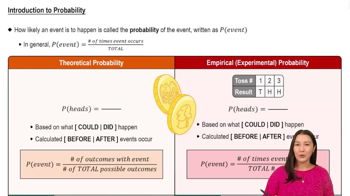
Probability is a measure of the likelihood that a particular event will occur, expressed as a number between 0 and 1. In this context, the probability of each child being a girl is 0.5, since there are two equally likely outcomes: boy or girl. Understanding how to calculate probabilities is essential for solving questions related to random events.
Recommended video:
5:37
Introduction to Probability

Independent Events

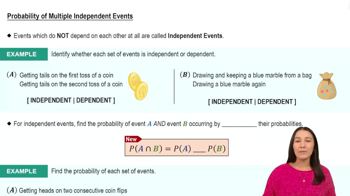
Independent events are those whose outcomes do not affect each other. In this scenario, the gender of each child is independent of the others, meaning the outcome of one child's gender does not influence the others. This concept is crucial for calculating the overall probability of multiple events occurring together.
Recommended video:
05:54
Probability of Multiple Independent Events

Multiplication Rule of Probability

The multiplication rule of probability states that the probability of multiple independent events occurring together is the product of their individual probabilities. For this question, to find the probability that all three children are girls, you would multiply the probability of each child being a girl (0.5) three times, resulting in (0.5) × (0.5) × (0.5).
Recommended video:
05:54
Probability of Multiple Independent Events
Related Practice
Textbook Question

Using a Pie Chart to Find Probabilities In Exercises 83-86, use the pie chart at the left, which shows the number of workers (in millions) by occupation for the United States. (Source: U.S. Bureau of Labor Statistics)

84. Find the probability that a worker chosen at random is not employed in a service occupation.

" style="" width="260">

126
views
Textbook Question

34. Lottery Number Selection A lottery has 52 numbers. In how many different ways can six of the numbers be selected? (Assume the order of selection is not important.)

126
views
Textbook Question

"Classifying Events as Independent or Dependent In Exercises 9-14, determine whether the events are independent or dependent. Explain your reasoning.

13. Rolling a six-sided die and then rolling the die a second time so that the sum of the two rolls is five"

65
views
Textbook Question

"Classifying Events Based on Studies In Exercises 15-18, identify the two events described in the study. Do the results indicate that the events are independent or dependent? Explain your reasoning.

16. A study found no significant association between the use of talc powder and the incidence of ovarian cancer in women. (Source: JAMA)"

39
views
Textbook Question

According to Bayes’ Theorem, the probability of event A , given that event B has occurred, is

P(A|B) = P(A) * P(B|A)P(A) * P(B|A) + P(A') * P(B|A').

In Exercises 33–38, use Bayes’ Theorem to find P(A|B).

37. P(A) = 73%, P(A') = 17%, P(B|A) = 46% , and P(B|A') = 52%

108
views
Textbook Question

20. Skating Eight people compete in a short track speed skating race. Assuming that there are no ties, in how many different orders can the skaters finish?

107
views