
Textbook Question
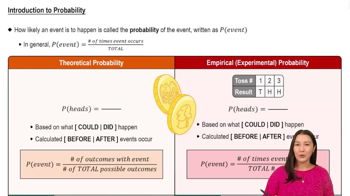
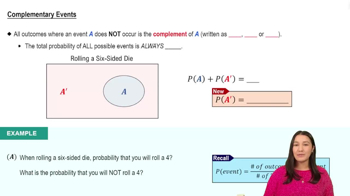
1. When two events are mutually exclusive, why is P(A and B) = 0?
264
views

 Verified step by step guidance
 5:37
5:37
 4:23
4:23 03:28
03:281. When two events are mutually exclusive, why is P(A and B) = 0?
True or False? In Exercises 3-6, determine whether the statement is true or false. If it is false, rewrite it as a true statement.
3. A combination is an ordered arrangement of objects.
Cards In Exercises 59-62, you are dealt a hand of five cards from a standard deck of 52 playing cards.
62. Find the probability of being dealt three of a kind (the other two cards are different from each other).
Matching Probabilities In Exercises 11-16, match the event with its probability.
a. 0.95
b. 0.005
c. 0.25
d. 0
e. 0.375
f. 0.5
14. A game show contestant must randomly select a door. One door doubles her money while the other three doors leave her with no winnings. What is the probability she selects the
door that doubles her money?
Recognizing Mutually Exclusive Events In Exercises 9–12, determine whether the events are mutually exclusive. Explain your reasoning.
10. Event A: Randomly select a student with a birthday in April.
Event B: Randomly select a student with a birthday in May.
Classifying Types of Probability In Exercises 53-58, classify the statement as an example of classical probability, empirical probability, or subjective probability. Explain your reasoning.
55. An analyst feels that the probability of a team winning an upcoming game is 60%.