
Ch. 3 - Probability
Larson - Elementary Statistics: Picturing the World 8th Edition
Larson8th EditionElementary Statistics: Picturing the WorldISBN: 9780137493470Not the one you use?Change textbook
Chapter 3, Problem 3.4.62

Cards In Exercises 59-62, you are dealt a hand of five cards from a standard deck of 52 playing cards.
62. Find the probability of being dealt three of a kind (the other two cards are different from each other).

Verified step by step guidance
1
Step 1: Understand the problem. A standard deck of 52 cards has 4 suits (hearts, diamonds, clubs, spades) and 13 ranks (Ace, 2, 3, ..., King). 'Three of a kind' means you have three cards of the same rank and two other cards of different ranks and suits. The goal is to calculate the probability of this specific hand being dealt.
Step 2: Calculate the number of ways to choose the rank for the three of a kind. There are 13 possible ranks, and you need to choose 1. This can be represented as \( \binom{13}{1} \). For the chosen rank, there are 4 suits, and you need to select 3 suits out of 4. This can be represented as \( \binom{4}{3} \). Multiply these two values to get the total number of ways to form the three of a kind.
Step 3: Calculate the number of ways to choose the ranks and suits for the other two cards. First, choose 2 different ranks from the remaining 12 ranks (since one rank is already used for the three of a kind). This can be represented as \( \binom{12}{2} \). For each of these two ranks, you can choose 1 suit out of 4. This can be represented as \( 4 \times 4 \) (since there are 4 suits for each of the two ranks). Multiply these values to get the total number of ways to choose the other two cards.
Step 4: Calculate the total number of possible 5-card hands. A standard deck has 52 cards, and you are dealt 5 cards. The total number of possible hands can be represented as \( \binom{52}{5} \).
Step 5: Calculate the probability of being dealt three of a kind. Divide the total number of favorable outcomes (calculated in Steps 2 and 3) by the total number of possible hands (calculated in Step 4). The formula for the probability is \( P = \frac{\text{Favorable Outcomes}}{\text{Total Outcomes}} \).

Verified video answer for a similar problem:

This video solution was recommended by our tutors as helpful for the problem above.
Video duration:
5m
Was this helpful?

Key Concepts

Here are the essential concepts you must grasp in order to answer the question correctly.

Probability

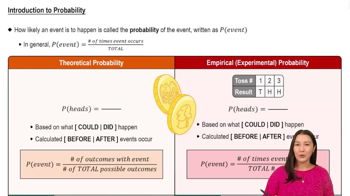
Probability is a measure of the likelihood that a particular event will occur, expressed as a number between 0 and 1. In the context of card games, it quantifies the chances of being dealt specific hands, such as three of a kind. Understanding probability involves calculating favorable outcomes over total possible outcomes, which is essential for determining the likelihood of various card combinations.
Recommended video:
5:37
Introduction to Probability

Combinatorics

Combinatorics is a branch of mathematics dealing with counting, arrangement, and combination of objects. In this scenario, it helps in calculating the number of ways to choose cards from a deck. For example, to find the number of ways to get three of a kind, one must consider the selection of ranks and suits, which requires combinatorial reasoning to ensure all possible configurations are accounted for.

Standard Deck of Cards

A standard deck of cards consists of 52 cards divided into four suits: hearts, diamonds, clubs, and spades, each containing 13 ranks. Understanding the structure of a standard deck is crucial for calculating probabilities in card games. Each hand dealt from this deck can be analyzed based on the combinations of ranks and suits, which is fundamental for determining specific hands like three of a kind.
Recommended video:
Guided course
08:45
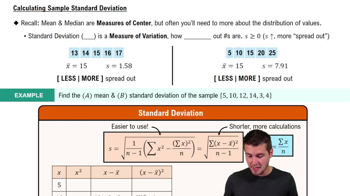
Calculating Standard Deviation