Ch. 4 - Discrete Probability Distributions
Larson - Elementary Statistics: Picturing the World 8th Edition
Larson8th EditionElementary Statistics: Picturing the WorldISBN: 9780137493470Not the one you use?Change textbook
Chapter 4, Problem 4.1.37

Finding an Expected Value In Exercises 37 and 38, find the expected value E(x) to the player for one play of the game. If x is the gain to a player in a game of chance, then E(x) is usually negative. This value gives the average amount per game the player can expect to lose.


In American roulette, the wheel has the 38 numbers, 00, 0, 1, 2, . . ., 34, 35, and 36, marked on equally spaced slots. If a player bets \$1 on a number and wins, then the player keeps the dollar and receives an additional \$35. Otherwise, the dollar is lost.

Verified step by step guidance
1
Step 1: Understand the problem. The expected value E(x) represents the average gain or loss per game for the player. To calculate E(x), we use the formula E(x) = Σ [x * P(x)], where x is the outcome (gain or loss) and P(x) is the probability of that outcome.
Step 2: Identify the possible outcomes. In this game, there are two outcomes: (1) The player wins, gaining \$35 in addition to keeping their \$1 bet, for a total gain of \$36. (2) The player loses, losing their \$1 bet, for a total loss of \$1.
Step 3: Determine the probabilities of each outcome. There are 38 equally likely slots on the roulette wheel. The probability of winning (P(win)) is 1/38, as there is only one winning slot. The probability of losing (P(lose)) is 37/38, as there are 37 losing slots.
Step 4: Calculate the expected value using the formula E(x) = Σ [x * P(x)]. Substitute the values: E(x) = (36 * P(win)) + (-1 * P(lose)). Replace P(win) with 1/38 and P(lose) with 37/38.
Step 5: Simplify the expression. Combine the terms to find the expected value. This will give you the average gain or loss per game for the player. Note that the result is typically negative, indicating an expected loss for the player.

Verified video answer for a similar problem:

This video solution was recommended by our tutors as helpful for the problem above.
Video duration:
4m
Was this helpful?

Key Concepts

Here are the essential concepts you must grasp in order to answer the question correctly.

Expected Value

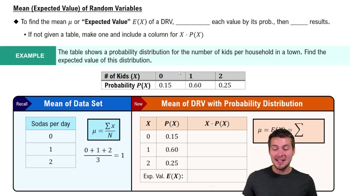
Expected value (E(x)) is a fundamental concept in probability and statistics that represents the average outcome of a random variable over many trials. It is calculated by multiplying each possible outcome by its probability and summing these products. In games of chance, the expected value often indicates the average loss or gain a player can anticipate per game, helping to assess the fairness of the game.
Recommended video:
Guided course
04:14
Expected Value (Mean) of Random Variables

Probability

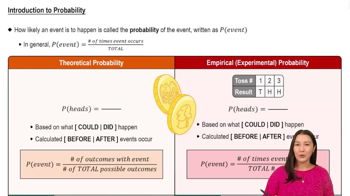
Probability is a measure of the likelihood that a particular event will occur, expressed as a number between 0 and 1. In the context of games like roulette, it is essential to understand the probabilities associated with winning and losing bets. For example, in American roulette, the probability of winning a bet on a single number is 1/38, while the probability of losing is 37/38, which directly influences the expected value.
Recommended video:
5:37
Introduction to Probability

Game of Chance

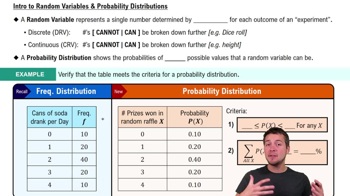
A game of chance is a game whose outcome is strongly influenced by randomizing devices, such as dice, cards, or roulette wheels, rather than skill. In such games, players often face a negative expected value, meaning they are likely to lose money over time. Understanding the mechanics of these games, including payouts and probabilities, is crucial for calculating the expected value and making informed betting decisions.
Recommended video:
Guided course
07:09
Intro to Random Variables & Probability Distributions
Related Practice
Textbook Question

Mean, Variance, and Standard Deviation In Exercises 11–14, find the mean, variance, and standard deviation of the binomial distribution with the given values of n and p.

n = 316, p = 0.82

94
views

Textbook Question

Constructing and Graphing Discrete Probability Distributions In Exercises 19 and 20, (a) construct a probability distribution, and (b) graph the probability distribution using a histogram and describe its shape.


Televisions The number of high-definition (HD) televisions per household in a small town

131
views
Textbook Question

In your own words, describe the difference between the value of x in a binomial distribution and in the Poisson distribution.

143
views
Textbook Question

Identifying Probability Distributions In Exercises 27 and 28, determine whether the distribution is a probability distribution. If it is not a probability distribution, explain why.

195
views
Textbook Question

Graphical Analysis In Exercises 3–5, the histogram represents a binomial distribution with five trials. Match the histogram with the appropriate probability of success p. Explain your reasoning.

a. p = 0.25

b. p = 0.50

c. p = 0.75


81
views
Textbook Question

"Using a Distribution to Find Probabilities In Exercises 11–26, find the indicated probabilities using the geometric distribution, the Poisson distribution, or the binomial distribution. Then determine whether the events are unusual. If convenient, use a table or technology to find the probabilities.


Hurricanes The mean number of hurricanes to strike the U.S. mainland per year from 1851 through 2020 was about 1.8. Find the probability that the number of hurricanes striking the U.S. mainland in any given year from 1851 through 2020 is (a) exactly one, (b) at most one, and (c) more than one. (Source: National Oceanic & Atmospheric Administration)"

83
views