Ch. 4 - Discrete Probability Distributions
Larson - Elementary Statistics: Picturing the World 8th Edition
Larson8th EditionElementary Statistics: Picturing the WorldISBN: 9780137493470Not the one you use?Change textbook
Chapter 4, Problem 4.2.14

Mean, Variance, and Standard Deviation In Exercises 11–14, find the mean, variance, and standard deviation of the binomial distribution with the given values of n and p.
n = 316, p = 0.82

Verified step by step guidance
1
Step 1: Recall the formulas for the mean, variance, and standard deviation of a binomial distribution. The mean (μ) is given by μ = n × p, the variance (σ²) is given by σ² = n × p × (1 - p), and the standard deviation (σ) is the square root of the variance, σ = √(σ²).
Step 2: Substitute the given values into the formula for the mean. Here, n = 316 and p = 0.82. So, μ = 316 × 0.82.
Step 3: Substitute the given values into the formula for the variance. Using n = 316 and p = 0.82, calculate σ² = 316 × 0.82 × (1 - 0.82).
Step 4: Compute the standard deviation by taking the square root of the variance. Use the formula σ = √(σ²) and substitute the value of the variance obtained in Step 3.
Step 5: Interpret the results. The mean represents the expected number of successes, the variance measures the spread of the distribution, and the standard deviation provides a measure of the average deviation from the mean.

Verified video answer for a similar problem:

This video solution was recommended by our tutors as helpful for the problem above.
Video duration:
2m
Was this helpful?

Key Concepts

Here are the essential concepts you must grasp in order to answer the question correctly.

Binomial Distribution

The binomial distribution models the number of successes in a fixed number of independent Bernoulli trials, each with the same probability of success. It is characterized by two parameters: n (the number of trials) and p (the probability of success on each trial). This distribution is applicable in scenarios where there are two possible outcomes, such as success or failure.
Recommended video:
Guided course
03:28
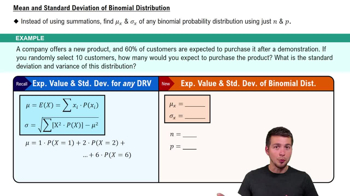
Mean & Standard Deviation of Binomial Distribution

Mean of a Binomial Distribution

The mean of a binomial distribution, also known as the expected value, is calculated using the formula μ = n * p. This value represents the average number of successes expected in n trials, providing a central point around which the distribution is centered. For the given values of n and p, the mean indicates how many successes we anticipate.
Recommended video:
Guided course
03:28
Mean & Standard Deviation of Binomial Distribution

Variance and Standard Deviation

Variance measures the spread of a distribution and is calculated for a binomial distribution using the formula σ² = n * p * (1 - p). The standard deviation, which is the square root of the variance, provides a measure of the average distance of each data point from the mean. These metrics help in understanding the variability and reliability of the outcomes in the context of the binomial distribution.
Recommended video:
Guided course
08:45
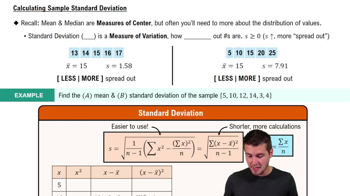
Calculating Standard Deviation
Related Practice
Textbook Question

In Exercises 1–4, find the indicated probability using the geometric distribution.

Find P(3) when p = 0.65

124
views

Textbook Question

Constructing and Graphing Discrete Probability Distributions In Exercises 19 and 20, (a) construct a probability distribution, and (b) graph the probability distribution using a histogram and describe its shape.


Televisions The number of high-definition (HD) televisions per household in a small town

131
views
Textbook Question

In your own words, describe the difference between the value of x in a binomial distribution and in the Poisson distribution.

143
views
Textbook Question

Finding an Expected Value In Exercises 37 and 38, find the expected value E(x) to the player for one play of the game. If x is the gain to a player in a game of chance, then E(x) is usually negative. This value gives the average amount per game the player can expect to lose.


In American roulette, the wheel has the 38 numbers, 00, 0, 1, 2, . . ., 34, 35, and 36, marked on equally spaced slots. If a player bets \$1 on a number and wins, then the player keeps the dollar and receives an additional \$35. Otherwise, the dollar is lost.

112
views
Textbook Question

Graphical Analysis In Exercises 3–5, the histogram represents a binomial distribution with five trials. Match the histogram with the appropriate probability of success p. Explain your reasoning.

a. p = 0.25

b. p = 0.50

c. p = 0.75

118
views
Textbook Question

Mean, Variance, and Standard Deviation In Exercises 11–14, find the mean, variance, and standard deviation of the binomial distribution with the given values of n and p.

n = 50, p = 0.4

140
views