
Ch. 4 - Discrete Probability Distributions
Larson - Elementary Statistics: Picturing the World 8th Edition
Larson8th EditionElementary Statistics: Picturing the WorldISBN: 9780137493470Not the one you use?Change textbook
Chapter 4, Problem 4.2.22

Finding Binomial Probabilities In Exercises 19–26, find the indicated probabilities. If convenient, use technology or Table 2 in Appendix B.


Penalty Kicks Argentine soccer player Lionel Messi converts 78% of his penalty kicks. Suppose Messi takes six penalty kicks next season. Find the probability that the number he converts is (a) exactly six, (b) at most three, and (c) more than three. (Source: Transfermarkt)

Verified step by step guidance
1
Step 1: Recognize that this is a binomial probability problem. The binomial distribution is used when there are a fixed number of independent trials (n), each with two possible outcomes (success or failure), and the probability of success (p) is constant. Here, n = 6 (penalty kicks), p = 0.78 (probability of converting a penalty kick), and q = 1 - p = 0.22 (probability of missing a penalty kick).
Step 2: Use the binomial probability formula to calculate the probability of exactly six successes (part a). The formula is: P(X = k) = (n choose k) * p^k * q^(n-k), where 'k' is the number of successes. For part (a), substitute k = 6, n = 6, p = 0.78, and q = 0.22 into the formula.
Step 3: For part (b), calculate the probability of at most three successes (P(X ≤ 3)). This is the sum of the probabilities for X = 0, X = 1, X = 2, and X = 3. Use the binomial probability formula for each value of k (0 through 3) and sum the results: P(X ≤ 3) = P(X = 0) + P(X = 1) + P(X = 2) + P(X = 3).
Step 4: For part (c), calculate the probability of more than three successes (P(X > 3)). This is the complement of P(X ≤ 3), so use the formula: P(X > 3) = 1 - P(X ≤ 3). Use the result from part (b) to find this value.
Step 5: If convenient, use technology (e.g., a statistical calculator, spreadsheet software, or statistical software) to compute the binomial probabilities for each part. Alternatively, use Table 2 in Appendix B if it provides cumulative binomial probabilities for the given parameters.

Verified video answer for a similar problem:

This video solution was recommended by our tutors as helpful for the problem above.
Video duration:
4m
Was this helpful?

Key Concepts

Here are the essential concepts you must grasp in order to answer the question correctly.

Binomial Distribution

The binomial distribution models the number of successes in a fixed number of independent Bernoulli trials, each with the same probability of success. In this context, Messi's penalty kicks represent the trials, where a success is defined as converting a kick. The distribution is characterized by two parameters: the number of trials (n) and the probability of success (p).
Recommended video:
Guided course
03:28
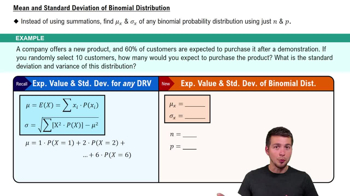
Mean & Standard Deviation of Binomial Distribution

Probability Mass Function (PMF)

The probability mass function for a binomial distribution gives the probability of obtaining exactly k successes in n trials. It is calculated using the formula P(X = k) = (n choose k) * p^k * (1-p)^(n-k). This function is essential for determining the probabilities of Messi converting a specific number of penalty kicks, such as exactly six or at most three.
Recommended video:
5:37
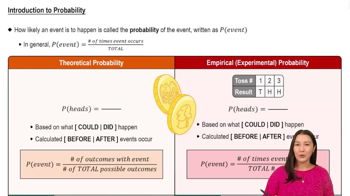
Introduction to Probability

Cumulative Probability

Cumulative probability refers to the probability that a random variable takes on a value less than or equal to a certain number. For the given problem, calculating the probability of Messi converting at most three kicks involves summing the probabilities of converting zero, one, two, or three kicks. This concept is crucial for answering parts (b) and (c) of the question.
Recommended video:
5:37
Introduction to Probability
Related Practice
Textbook Question

Baseball There were 116 World Series from 1903 to 2020. Use the probability distribution in Exercise 30 to find the number of World Series that had 4, 5, 6, 7, and 8 games. Find the population mean, variance, and standard deviation of the data using the traditional definitions. Compare to your answers in Exercise 30.

77
views
Textbook Question

In Exercises 1–4, find the indicated probability using the geometric distribution.


Find P(5) when p = 0.09

135
views
Textbook Question

Graphical Analysis In Exercises 9–12, determine whether the graph on the number line represents a discrete random variable or a continuous random variable. Explain your reasoning.


The attendance at concerts for a rock group

95
views
Textbook Question

Constructing and Graphing Binomial Distributions In Exercises 27–30, (a) construct a binomial distribution, (b) graph the binomial distribution using a histogram and describe its shape, and (c) identify any values of the random variable x that you would consider unusual. Explain your reasoning.


College Acceptance Pennsylvania State University accepts 49% of applicants. You randomly select seven Pennsylvania State University applicants. The random variable represents the number who are accepted. (Source: US News & World Report)

133
views
Textbook Question

True or False? In Exercises 5–8, determine whether the statement is true or false. If it is false, rewrite it as a true statement.


For a random variable x, the word random indicates that the value of x is determined by chance.

103
views
Textbook Question

Finding the Mean, Variance, and Standard Deviation In Exercises 29–34, (a) find the mean, variance, and standard deviation of the probability distribution, and (b) interpret the results.

Machine Parts The number of defects per 1000 machine parts inspected

84
views