
Ch. 4 - Discrete Probability Distributions
Larson - Elementary Statistics: Picturing the World 8th Edition
Larson8th EditionElementary Statistics: Picturing the WorldISBN: 9780137493470Not the one you use?Change textbook
Chapter 4, Problem 4.1.31

Finding the Mean, Variance, and Standard Deviation In Exercises 29–34, (a) find the mean, variance, and standard deviation of the probability distribution, and (b) interpret the results.
Machine Parts The number of defects per 1000 machine parts inspected
tab1

Verified step by step guidance
1
Step 1: To find the mean (expected value) of the probability distribution, use the formula: μ=xxP(x). Multiply each defect value (x) by its corresponding probability P(x), then sum all the products.
Step 2: To find the variance, use the formula: σ²=x(xμ)2P(x). First, calculate the squared difference between each defect value and the mean, then multiply each squared difference by its corresponding probability, and finally sum all the products.
Step 3: To find the standard deviation, take the square root of the variance using the formula: σ=σ². This provides a measure of the spread of the distribution.
Step 4: Interpret the mean. The mean represents the average number of defects per 1000 machine parts inspected. It provides a central value for the distribution.
Step 5: Interpret the standard deviation. The standard deviation indicates the variability or spread of the number of defects around the mean. A smaller standard deviation suggests that the defects are more consistently close to the mean, while a larger standard deviation indicates greater variability.

Verified video answer for a similar problem:

This video solution was recommended by our tutors as helpful for the problem above.
Video duration:
7m
Was this helpful?

Key Concepts

Here are the essential concepts you must grasp in order to answer the question correctly.

Mean

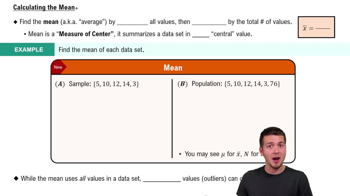
The mean, or expected value, of a probability distribution is calculated by multiplying each possible outcome by its probability and summing these products. It represents the average number of defects expected per 1000 machine parts inspected. In this case, it provides a central value around which the number of defects is likely to cluster.
Recommended video:
Guided course
04:52
Calculating the Mean

Variance

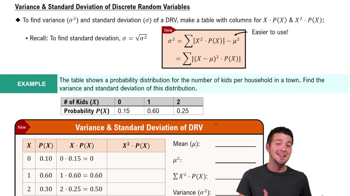
Variance measures the spread of a probability distribution by calculating the average of the squared differences from the mean. It quantifies how much the number of defects varies from the mean value. A higher variance indicates a wider spread of defect counts, while a lower variance suggests that the defect counts are more closely clustered around the mean.
Recommended video:
Guided course
04:48
Variance & Standard Deviation of Discrete Random Variables

Standard Deviation

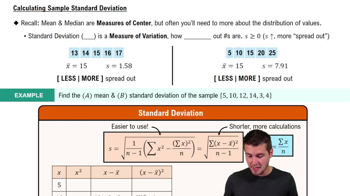
Standard deviation is the square root of the variance and provides a measure of dispersion in the same units as the data. It indicates how much the number of defects typically deviates from the mean. A smaller standard deviation implies that the defect counts are consistently close to the mean, while a larger standard deviation indicates greater variability in the number of defects.
Recommended video:
Guided course
08:45
Calculating Standard Deviation
Related Practice
Textbook Question

Finding Binomial Probabilities In Exercises 19–26, find the indicated probabilities. If convenient, use technology or Table 2 in Appendix B.


Penalty Kicks Argentine soccer player Lionel Messi converts 78% of his penalty kicks. Suppose Messi takes six penalty kicks next season. Find the probability that the number he converts is (a) exactly six, (b) at most three, and (c) more than three. (Source: Transfermarkt)

99
views
Textbook Question

Graphical Analysis In Exercises 9–12, determine whether the graph on the number line represents a discrete random variable or a continuous random variable. Explain your reasoning.


The attendance at concerts for a rock group

95
views
Textbook Question

Identifying and Understanding Binomial Experiments In Exercises 15–18, determine whether the experiment is a binomial experiment. If it is, identify a success; specify the values of n, p, and q; and list the possible values of the random variable x. If it is not a binomial experiment, explain why.


Video Games A survey found that 29% of gamers own a virtual reality (VR) device. Ten gamers are randomly selected. The random variable represents the number who own a VR device. (Source: Entertainment Software Association)

111
views
Textbook Question

Identifying and Understanding Binomial Experiments In Exercises 15–18, determine whether the experiment is a binomial experiment. If it is, identify a success; specify the values of n, p, and q; and list the possible values of the random variable x. If it is not a binomial experiment, explain why.


Basketball A’ja Wilson, the 2020 WNBA Most Valuable Player, makes a free throw shot about 78% of the time. The random variable represents the number of free throws that she makes on eight attempts. (Source: Women’s National Basketball Association)

165
views
Textbook Question

Constructing and Graphing Binomial Distributions In Exercises 27–30, (a) construct a binomial distribution, (b) graph the binomial distribution using a histogram and describe its shape, and (c) identify any values of the random variable x that you would consider unusual. Explain your reasoning.


College Acceptance Pennsylvania State University accepts 49% of applicants. You randomly select seven Pennsylvania State University applicants. The random variable represents the number who are accepted. (Source: US News & World Report)

133
views
Textbook Question

Discrete Variables and Continuous Variables In Exercises 13–18, determine whether the random variable x is discrete or continuous. Explain.


Let x represent the length of time it takes to complete an exam.

62
views