
Ch. 5 - Normal Probability Distributions
Larson - Elementary Statistics: Picturing the World 8th Edition
Larson8th EditionElementary Statistics: Picturing the WorldISBN: 9780137493470Not the one you use?Change textbook
Chapter 5, Problem 5.CR.12b

Forty-nine percent of U.S. adults think that human activity such as burning fossil fuels contributes a great deal to climate change. You randomly select 25 U.S. adults. Find the probability that the number who think that human activity contributes a great deal to climate change is (b) between 8 and 11, inclusive,

Verified step by step guidance
1
Step 1: Recognize that this is a binomial probability problem. The problem involves a fixed number of trials (n = 25), two possible outcomes (success: the person thinks human activity contributes a great deal to climate change, and failure: they do not), and a constant probability of success (p = 0.49).
Step 2: Define the random variable X as the number of U.S. adults in the sample of 25 who think human activity contributes a great deal to climate change. X follows a binomial distribution: X ~ Binomial(n = 25, p = 0.49).
Step 3: To find the probability that the number of successes is between 8 and 11 inclusive, calculate P(8 ≤ X ≤ 11). This can be expressed as the sum of individual probabilities: P(8 ≤ X ≤ 11) = P(X = 8) + P(X = 9) + P(X = 10) + P(X = 11).
Step 4: Use the binomial probability formula to calculate each term: P(X = k) = (n choose k) * p^k * (1-p)^(n-k), where (n choose k) = n! / [k! * (n-k)!]. Substitute n = 25, p = 0.49, and k = 8, 9, 10, and 11 to compute each probability.
Step 5: Add the probabilities calculated in Step 4 to find the total probability P(8 ≤ X ≤ 11). Alternatively, use statistical software or a calculator with a binomial probability function to compute the cumulative probability directly.

Verified video answer for a similar problem:

This video solution was recommended by our tutors as helpful for the problem above.
Video duration:
6m
Was this helpful?

Key Concepts

Here are the essential concepts you must grasp in order to answer the question correctly.

Binomial Distribution

The binomial distribution models the number of successes in a fixed number of independent Bernoulli trials, each with the same probability of success. In this context, each selected adult either believes that human activity contributes to climate change (success) or does not (failure). The parameters of the distribution are the number of trials (n = 25) and the probability of success (p = 0.49).
Recommended video:
Guided course
03:28
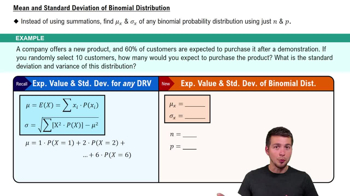
Mean & Standard Deviation of Binomial Distribution

Probability Mass Function (PMF)

The probability mass function gives the probability of obtaining a specific number of successes in a binomial distribution. For a given number of successes k, the PMF is calculated using the formula P(X = k) = (n choose k) * p^k * (1-p)^(n-k). This function is essential for determining the probability of observing between 8 and 11 adults who believe in the contribution of human activity to climate change.
Recommended video:
5:37
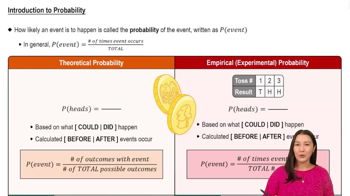
Introduction to Probability

Cumulative Probability

Cumulative probability refers to the probability that a random variable takes on a value less than or equal to a certain number. To find the probability that the number of adults believing in human activity's contribution to climate change is between 8 and 11, one would calculate the cumulative probabilities for 11 and 7, then subtract the two. This approach allows for the determination of the probability of a range of outcomes.
Recommended video:
5:37
Introduction to Probability
Related Practice
Textbook Question

In a survey of U.S. adults, 81% feel they have little or no control over data collected about them by companies. You randomly select 250 U.S. adults and ask them whether they feel they have control over data collected about them by companies. Use this information in Exercises 11 and 12. (Source: Pew Research Center)


Determine whether you can use a normal distribution to approximate the binomial distribution. If you can, find the mean and standard deviation. If you cannot, explain why.

97
views
Textbook Question

Forty-nine percent of U.S. adults think that human activity such as burning fossil fuels contributes a great deal to climate change. You randomly select 25 U.S. adults. Find the probability that the number who think that human activity contributes a great deal to climate change is (c) less than two. (d) Are any of these events unusual? Explain your reasoning.

84
views
Textbook Question

A survey of adults in the United States found that 61% ate at a restaurant at least once in the past week. You randomly select 30 adults and ask them whether they ate at a restaurant at least once in the past week. (Source: Gallup)


c. Is it unusual for exactly 14 out of 30 adults to have eaten in a restaurant at least once in the past week? Explain your reasoning.

69
views
Textbook Question

The life spans of car batteries are normally distributed, with a mean of 44 months and a standard deviation of 5 months.


c. What is the shortest life expectancy a car battery can have and still be in the top 5% of life expectancies?

96
views
Textbook Question

In a standardized IQ test, scores are normally distributed, with a mean score of 100 and a standardized deviation of 15. Use this information in Exercises 3–10. (Adapted from 123test)

What is the highest score that would still place a person in the bottom 10% of the scores?

171
views
Textbook Question

Use the probability distribution in Exercise 3 to find the probability of randomly selecting a game in which DeMar DeRozan had (c) between two and four personal fouls, inclusive.

89
views