
Forty-nine percent of U.S. adults think that human activity such as burning fossil fuels contributes a great deal to climate change. You randomly select 25 U.S. adults. Find the probability that the number who think that human activity contributes a great deal to climate change is (c) less than two. (d) Are any of these events unusual? Explain your reasoning.
In a survey of U.S. adults, 81% feel they have little or no control over data collected about them by companies. You randomly select 250 U.S. adults and ask them whether they feel they have control over data collected about them by companies. Use this information in Exercises 11 and 12. (Source: Pew Research Center)
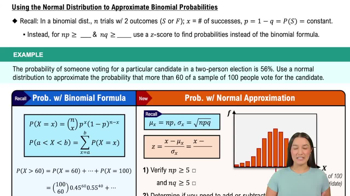
Determine whether you can use a normal distribution to approximate the binomial distribution. If you can, find the mean and standard deviation. If you cannot, explain why.
Verified step by step guidance
Verified video answer for a similar problem:
Key Concepts
Binomial Distribution
Normal Approximation
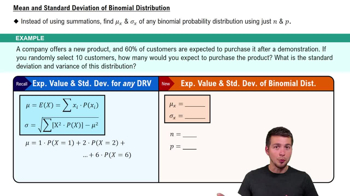
Mean and Standard Deviation of a Binomial Distribution
Find each probability using the standard normal distribution.
b. P(z < 2.23)
In a standardized IQ test, scores are normally distributed, with a mean score of 100 and a standardized deviation of 15. Use this information in Exercises 3–10. (Adapted from 123test)
What percent of the IQ scores are greater than 112?
Forty-nine percent of U.S. adults think that human activity such as burning fossil fuels contributes a great deal to climate change. You randomly select 25 U.S. adults. Find the probability that the number who think that human activity contributes a great deal to climate change is (b) between 8 and 11, inclusive,
The life spans of car batteries are normally distributed, with a mean of 44 months and a standard deviation of 5 months.
c. What is the shortest life expectancy a car battery can have and still be in the top 5% of life expectancies?
In a standardized IQ test, scores are normally distributed, with a mean score of 100 and a standardized deviation of 15. Use this information in Exercises 3–10. (Adapted from 123test)
What is the highest score that would still place a person in the bottom 10% of the scores?
