Ch. 6 - Confidence Intervals
Larson - Elementary Statistics: Picturing the World 8th Edition
Larson8th EditionElementary Statistics: Picturing the WorldISBN: 9780137493470Not the one you use?Change textbook
Chapter 6, Problem 6.2.31

Constructing a Confidence Interval In Exercises 31 and 32, use the data set to (c) construct a 98% confidence interval for the population mean.
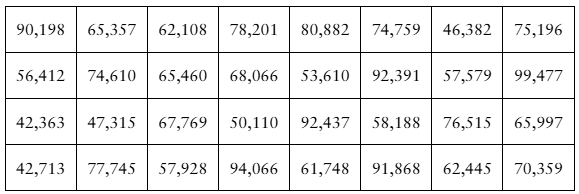
[APPLET] Earnings The annual earnings (in dollars) of 32 randomly selected intermediate level life insurance underwriters (Adapted from Salary.com)
Table displaying annual earnings (in dollars) of 32 randomly selected life insurance underwriters.

Verified step by step guidance
1
Step 1: Calculate the sample mean (x̄) by summing all the earnings data provided in the table and dividing by the total number of data points (n = 32). Use the formula: x=xn.
Step 2: Calculate the sample standard deviation (s) using the formula: s=(x-)2n-1, where x̄ is the sample mean and n is the sample size.
Step 3: Determine the critical value (z*) for a 98% confidence level. For a two-tailed test, look up the z-value corresponding to 98% confidence in a standard normal distribution table. This value is typically around 2.33.
Step 4: Calculate the margin of error (E) using the formula: E=z*×sn, where z* is the critical value, s is the sample standard deviation, and n is the sample size.
Step 5: Construct the confidence interval for the population mean using the formula: [-E,+E], where x̄ is the sample mean and E is the margin of error.

Verified video answer for a similar problem:

This video solution was recommended by our tutors as helpful for the problem above.
Video duration:
3m
Was this helpful?

Key Concepts

Here are the essential concepts you must grasp in order to answer the question correctly.

Confidence Interval

A confidence interval is a range of values, derived from sample statistics, that is likely to contain the population parameter with a specified level of confidence. For example, a 98% confidence interval suggests that if we were to take many samples and construct intervals in the same way, approximately 98% of those intervals would contain the true population mean.
Recommended video:
06:33
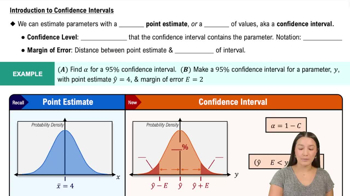
Introduction to Confidence Intervals

Population Mean

The population mean is the average of a set of values for an entire population. It is a parameter that represents the central tendency of the population data. In the context of the question, it refers to the average annual earnings of all life insurance underwriters, which we estimate using sample data.
Recommended video:
04:48
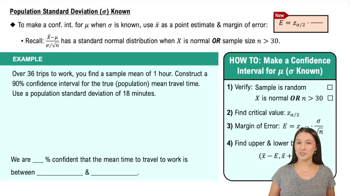
Population Standard Deviation Known

Sample Size

Sample size refers to the number of observations or data points collected from a population for analysis. In this case, the sample size is 32, which is crucial for calculating the confidence interval. A larger sample size generally leads to a more accurate estimate of the population mean and a narrower confidence interval.
Recommended video:
05:11
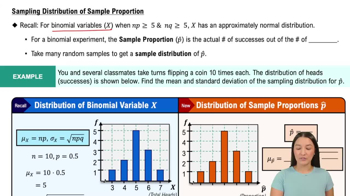
Sampling Distribution of Sample Proportion