
Ch. 6 - Confidence Intervals
Larson - Elementary Statistics: Picturing the World 8th Edition
Larson8th EditionElementary Statistics: Picturing the WorldISBN: 9780137493470Not the one you use?Change textbook
Chapter 6, Problem 6.3.5

Finding p^ and q^ In Exercises 3–6, let p be the population proportion for the situation. Find point estimates of p and q.
Social Security In a survey of 661 non-retired Americans, 218 said that they expect to rely on Social Security as major source of income when they retire. (Adapted from Gallup)

Verified step by step guidance
1
Step 1: Understand the problem. The goal is to find the point estimates of p (the sample proportion of individuals who expect to rely on Social Security as a major source of income) and q (the complement of p, representing those who do not expect to rely on Social Security).
Step 2: Recall the formula for the sample proportion p̂. It is given by: p^=xn, where x is the number of individuals with the characteristic of interest (218 in this case), and n is the total sample size (661 in this case).
Step 3: Substitute the given values into the formula for p̂. This will give you the point estimate for p̂: p^=218661.
Step 4: Recall that q̂ is the complement of p̂, which can be calculated using the formula: q^=1-p^. Use the value of p̂ from Step 3 to compute q̂.
Step 5: Interpret the results. The values of p̂ and q̂ represent the proportions of the sample that expect to rely on Social Security and do not expect to rely on Social Security, respectively.

Verified video answer for a similar problem:

This video solution was recommended by our tutors as helpful for the problem above.
Video duration:
1m
Was this helpful?

Key Concepts

Here are the essential concepts you must grasp in order to answer the question correctly.

Population Proportion

The population proportion, denoted as p, is the ratio of members of a population that have a particular characteristic to the total number of members in that population. In this context, it represents the proportion of non-retired Americans who expect to rely on Social Security as a major source of income when they retire.
Recommended video:
05:45
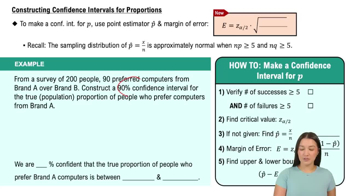
Constructing Confidence Intervals for Proportions

Point Estimate

A point estimate is a single value that serves as an approximation of a population parameter. In this case, p^ (p-hat) is the point estimate of the population proportion p, calculated from sample data. It provides a quick summary of the sample's characteristics, allowing for easier interpretation of the data.
Recommended video:
06:33
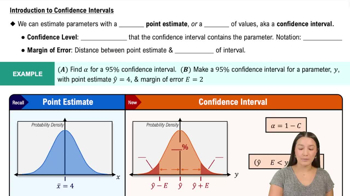
Introduction to Confidence Intervals

Complement of the Population Proportion

The complement of the population proportion, denoted as q, represents the proportion of the population that does not have the characteristic of interest. It is calculated as q = 1 - p. In this scenario, q^ (q-hat) would indicate the proportion of non-retired Americans who do not expect to rely on Social Security as a major source of income.
Recommended video:
05:45
Constructing Confidence Intervals for Proportions
Related Practice
Textbook Question

Constructing a Confidence Interval In Exercises 31 and 32, use the data set to (c) construct a 98% confidence interval for the population mean.

[APPLET] Earnings The annual earnings (in dollars) of 32 randomly selected intermediate level life insurance underwriters (Adapted from Salary.com)

85
views
Textbook Question

Finding Critical Values for χ2 In Exercises 3–8, find the critical values χR2 and χL2 for the level of confidence c and sample size n.

c = 0.98, n = 26

94
views
Textbook Question

Translating Statements In Exercises 29–34, translate the statement into a confidence interval. Approximate the level of confidence.

In a survey of 1052 parents of children ages 8–14, 68% say they are willing to get a second or part-time job to pay for their children’s college education, and 42% say they lose sleep worrying about college costs. The survey’s margin of error is ±3%. (Source: T. Rowe Price Group, Inc.)

50
views
Textbook Question

In Exercises 9–12, construct the indicated confidence intervals for (a) the population variance and (b) the population standard deviation . Assume the sample is from a normally distributed population.

c = 0.95, s^2 = 11.56, n = 30

67
views
Textbook Question

Determining a Minimum Sample Size Determine the minimum sample size required when you want to be 99% confident that the sample mean is within two units of the population mean and σ = 1.4. Assume the population is normally distributed.

187
views
Textbook Question

For the same sample statistics, which level of confidence would produce the widest confidence interval? Explain your reasoning.

a. 90%

b. 95%

c. 98%

d. 99%

125
views