Ch. 6 - Confidence Intervals
Larson - Elementary Statistics: Picturing the World 8th Edition
Larson8th EditionElementary Statistics: Picturing the WorldISBN: 9780137493470Not the one you use?Change textbook
Chapter 6, Problem 6.1.13

In Exercises 13–16, find the margin of error for the values of c, σ and n.
c = 0.95, σ = 5.2, n = 30

Verified step by step guidance
1
Step 1: Understand the formula for the margin of error (ME). The formula is: ME = z * (σ / √n), where z is the critical value corresponding to the confidence level (c), σ is the population standard deviation, and n is the sample size.
Step 2: Determine the critical value (z) for the given confidence level (c = 0.95). For a 95% confidence level, the z-value can be found using a z-table or standard normal distribution. It is approximately 1.96.
Step 3: Plug in the given values into the formula. Here, σ = 5.2 and n = 30. The formula becomes: ME = 1.96 * (5.2 / √30).
Step 4: Simplify the denominator by calculating the square root of the sample size (n). Compute √30.
Step 5: Divide the population standard deviation (σ = 5.2) by the square root of the sample size (√30), then multiply the result by the critical value (z = 1.96) to find the margin of error.

Verified video answer for a similar problem:

This video solution was recommended by our tutors as helpful for the problem above.
Video duration:
1m
Was this helpful?

Key Concepts

Here are the essential concepts you must grasp in order to answer the question correctly.

Margin of Error

The margin of error quantifies the uncertainty in a sample estimate. It indicates the range within which the true population parameter is expected to lie, given a certain confidence level. A smaller margin of error suggests a more precise estimate, while a larger margin indicates more variability in the data.
Recommended video:
04:08
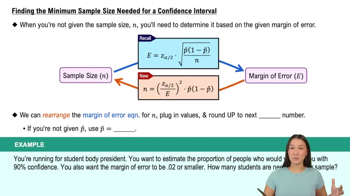
Finding the Minimum Sample Size Needed for a Confidence Interval

Confidence Level (c)

The confidence level represents the probability that the margin of error will contain the true population parameter. A confidence level of 0.95, for example, means that if the same sampling procedure were repeated multiple times, approximately 95% of the calculated margins of error would capture the true parameter.
Recommended video:
06:33
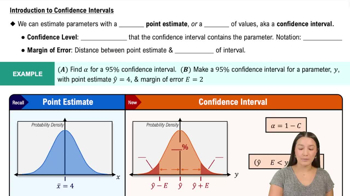
Introduction to Confidence Intervals

Standard Deviation (σ) and Sample Size (n)

Standard deviation (σ) measures the dispersion of data points around the mean, indicating how spread out the values are. The sample size (n) refers to the number of observations in the sample. Both σ and n are critical in calculating the margin of error, as they influence the precision of the estimate; larger samples generally yield smaller margins of error.
Recommended video:
Guided course
08:45
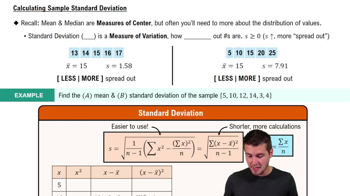
Calculating Standard Deviation
Related Practice
Textbook Question

In Exercise 35, would it be unusual for the population mean to be over \$1500? Explain.

46
views

Textbook Question

Tennis Ball Manufacturing A company manufactures tennis balls. When the balls are dropped onto a concrete surface from a height of 100 inches, the company wants the mean bounce height to be 55.5 inches. This average is maintained by periodically testing random samples of 25 tennis balls. If the t-value falls between and , then the company will be satisfied that it is manufacturing acceptable tennis balls. For a random sample, the mean bounce height of the sample is 56.0 inches and the standard deviation is 0.25 inch. Assume the bounce heights are approximately normally distributed. Is the company making acceptable tennis balls? Explain.

117
views
Textbook Question

In Exercises 5–8, find the critical value zc necessary to construct a confidence interval at the level of confidence c.

c = 0.97

136
views
Textbook Question

A researcher claims that 5% of people who wear eyeglasses purchase their eyeglasses online. Describe type I and type II errors for a hypothesis test of the claim. (Source: Consumer Reports)

37
views
Textbook Question

In Exercises 7 and 8, find the margin of error for the values of c, s, and n.

c = 0.95, s = 5, n = 16

125
views
Textbook Question

Drug Concentration You are analyzing the times for the drug concentrations to peak in the patients in Exercise 14. The population standard deviation of the times for epinephrine concentrations to peak should be less than 10 minutes. Does the confidence interval you constructed for σ suggest that the variation in the times is at an acceptable level? Explain your reasoning.

66
views