Ch. 6 - Confidence Intervals
Larson - Elementary Statistics: Picturing the World 8th Edition
Larson8th EditionElementary Statistics: Picturing the WorldISBN: 9780137493470Not the one you use?Change textbook
Chapter 6, Problem 6.1.8

In Exercises 5–8, find the critical value zc necessary to construct a confidence interval at the level of confidence c.
c = 0.97

Verified step by step guidance
1
Step 1: Understand the problem. The goal is to find the critical value (zc) for a confidence interval at a given confidence level (c = 0.97). The critical value corresponds to the z-score that separates the middle 97% of the standard normal distribution from the remaining 3%.
Step 2: Recall that the confidence level (c) represents the proportion of the area under the standard normal curve that is within the confidence interval. For c = 0.97, the remaining area outside the interval is 1 - c = 0.03, which is split equally between the two tails of the distribution.
Step 3: Calculate the area in one tail. Since the total area outside the confidence interval is 0.03, the area in one tail is 0.03 / 2 = 0.015.
Step 4: Determine the cumulative area to the left of the critical value zc. The cumulative area includes the area in the left tail (0.015) and the middle area (0.97). Therefore, the cumulative area is 0.015 + 0.97 = 0.985.
Step 5: Use a standard normal table or a statistical software to find the z-score (zc) corresponding to a cumulative area of 0.985. This z-score is the critical value zc needed for the confidence interval.

Verified video answer for a similar problem:

This video solution was recommended by our tutors as helpful for the problem above.
Video duration:
3m
Was this helpful?

Key Concepts

Here are the essential concepts you must grasp in order to answer the question correctly.

Critical Value (zc)

The critical value, denoted as zc, is a point on the standard normal distribution that corresponds to a specified level of confidence. It is used to determine the margin of error in constructing confidence intervals. For a given confidence level, zc represents the number of standard deviations away from the mean that captures the desired percentage of the data.
Recommended video:
05:50
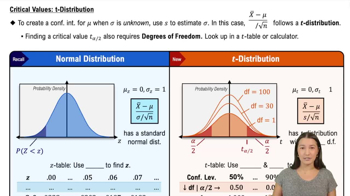
Critical Values: t-Distribution

Confidence Level

The confidence level, often expressed as a percentage (e.g., 97%), indicates the degree of certainty that the population parameter lies within the confidence interval. A higher confidence level means a wider interval, reflecting greater uncertainty about the exact value of the parameter. It is crucial for determining the critical value and the overall reliability of the interval estimate.
Recommended video:
06:33
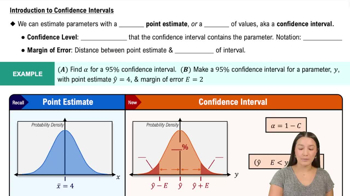
Introduction to Confidence Intervals

Standard Normal Distribution

The standard normal distribution is a probability distribution that has a mean of 0 and a standard deviation of 1. It is used as a reference for calculating probabilities and critical values in statistics. When constructing confidence intervals, the z-scores derived from this distribution help identify the critical values needed for the specified confidence level.
Recommended video:
Guided course
09:47
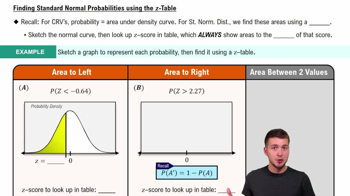
Finding Standard Normal Probabilities using z-Table
Related Practice
Textbook Question

In Exercise 35, would it be unusual for the population mean to be over \$1500? Explain.

46
views

Textbook Question

Tennis Ball Manufacturing A company manufactures tennis balls. When the balls are dropped onto a concrete surface from a height of 100 inches, the company wants the mean bounce height to be 55.5 inches. This average is maintained by periodically testing random samples of 25 tennis balls. If the t-value falls between and , then the company will be satisfied that it is manufacturing acceptable tennis balls. For a random sample, the mean bounce height of the sample is 56.0 inches and the standard deviation is 0.25 inch. Assume the bounce heights are approximately normally distributed. Is the company making acceptable tennis balls? Explain.

117
views
Textbook Question

Graphical Analysis In Exercises 9–12, use the values on the number line to find the sampling error.

49
views
Textbook Question

In Exercises 7 and 8, find the margin of error for the values of c, s, and n.

c = 0.95, s = 5, n = 16

125
views
Textbook Question

Drug Concentration You are analyzing the times for the drug concentrations to peak in the patients in Exercise 14. The population standard deviation of the times for epinephrine concentrations to peak should be less than 10 minutes. Does the confidence interval you constructed for σ suggest that the variation in the times is at an acceptable level? Explain your reasoning.

66
views
Textbook Question

In Exercises 13–16, find the margin of error for the values of c, σ and n.

c = 0.95, σ = 5.2, n = 30

154
views