Ch. 8 - Hypothesis Testing with Two Samples
Larson - Elementary Statistics: Picturing the World 8th Edition
Larson8th EditionElementary Statistics: Picturing the WorldISBN: 9780137493470Not the one you use?Change textbook
Chapter 8, Problem 8.3.23

Constructing Confidence Intervals for μd To construct a confidence interval for μd , use the inequality below.
Construct the indicated confidence interval for μd . Assume the populations are normally distributed.
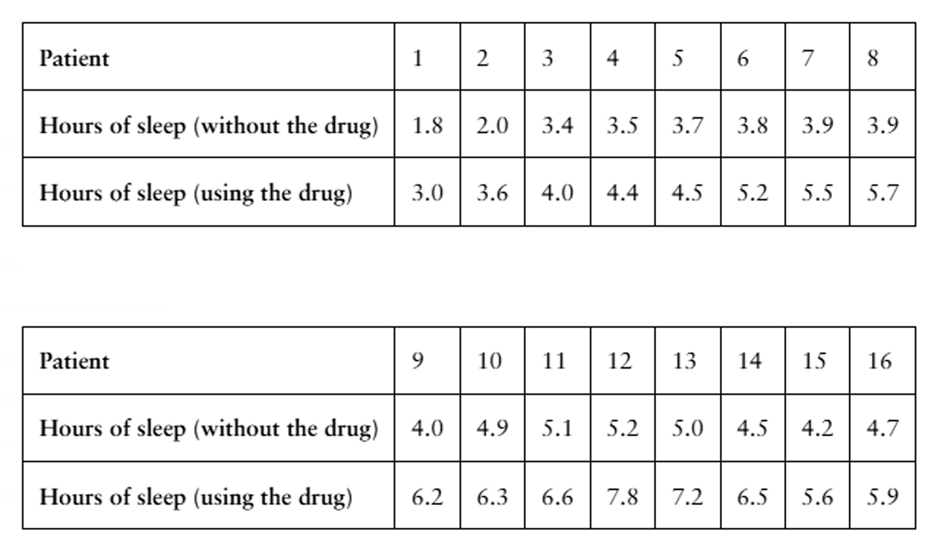
[APPLET] Drug Testing A sleep disorder specialist wants to test the effectiveness of a new drug that is reported to increase the number of hours of sleep patients get during the night. To do so, the specialist randomly selects 16 patients and records the number of hours of sleep each gets with and without the new drug. The table shows the results of the two-night study. Construct a 90% confidence interval for μd.
Table displaying hours of sleep for 16 patients, comparing results with and without a new drug.

Verified step by step guidance
1
Step 1: Calculate the differences (d) between the hours of sleep with the drug and without the drug for each patient. For each patient, subtract the 'Hours of sleep (without the drug)' from the 'Hours of sleep (using the drug)'.
Step 2: Compute the mean of the differences (d̄). Add all the differences calculated in Step 1 and divide by the total number of patients (n = 16). The formula is d̄ = (Σd) / n.
Step 3: Compute the standard deviation of the differences (sd). Use the formula sd = sqrt((Σ(d - d̄)^2) / (n - 1)), where d̄ is the mean difference calculated in Step 2.
Step 4: Determine the standard error of the mean difference (SEd). Use the formula SEd = sd / sqrt(n), where sd is the standard deviation of the differences and n is the number of patients.
Step 5: Construct the confidence interval for μd using the formula d̄ ± t*SEd, where t* is the critical t-value for a 90% confidence level and degrees of freedom (df = n - 1). Look up the t-value in a t-distribution table or use statistical software.

Verified video answer for a similar problem:

This video solution was recommended by our tutors as helpful for the problem above.
Video duration:
3m
Was this helpful?

Key Concepts

Here are the essential concepts you must grasp in order to answer the question correctly.

Confidence Interval

A confidence interval is a range of values, derived from sample statistics, that is likely to contain the true population parameter. It is expressed with a certain level of confidence, such as 90% or 95%, indicating the probability that the interval includes the parameter. In this case, we are constructing a confidence interval for the mean difference in hours of sleep with and without the drug.
Recommended video:
06:33
Introduction to Confidence Intervals

Paired Samples

Paired samples refer to two sets of related data points, typically collected from the same subjects under different conditions. In this scenario, the hours of sleep for each patient are measured both with and without the drug, allowing for a direct comparison of the effects of the drug on sleep duration. This method helps control for individual variability among subjects.
Recommended video:
Guided course
08:33
Introduction to Matched Pairs

Normal Distribution

Normal distribution is a probability distribution that is symmetric about the mean, showing that data near the mean are more frequent in occurrence than data far from the mean. In constructing confidence intervals, it is often assumed that the underlying population is normally distributed, especially when sample sizes are small, as is the case with the 16 patients in this study.
Recommended video:
06:23
Using the Normal Distribution to Approximate Binomial Probabilities
Related Practice
Textbook Question

In Exercises 3–6, determine whether a normal sampling distribution can be used. If it can be used, test the claim about the difference between two population proportions and at the level of significance . Assume the samples are random and independent.


Claim: p1≠p2, α=0.01


Sample statistics: x1=35, n1=70, and x2=36, n2=60

88
views
Textbook Question

Independent and Dependent Samples In Exercises 5–8, classify the two samples as independent or dependent and justify your answer.

Sample 1: The maximum bench press weights for 53 football players

Sample 2: The maximum bench press weights for the same 53 football players after completing a weight lifting program

75
views
Textbook Question

Test the claim about the difference between two population means and at the level of significance α. Assume the samples are random and independent, and the populations are normally distributed.

Claim: μ1=μ2, α=0.01, Assume (σ1)^2=(σ2)^2

Sample statistics:

x̅1=33.7, s1=3.5 , n1=12 and x̅2=35.5 , s2=2.2 , n2=17

118
views
Textbook Question

Constructing Confidence Intervals for μ1-μ2. When the sampling distribution for x̅1-x̅2 is approximated by a t-distribution and the populations have equal variances, you can construct a confidence interval for μ1-μ2, as shown below.

Construct the indicated confidence interval for μ1-μ2 . Assume the populations are approximately normal with equal variances.

Family Doctor 

To compare the mean number of days spent waiting to see a family doctor for two large cities, you randomly select several people in each city who have had an appointment with a family doctor. The results are shown at the left. Construct a 90% confidence interval for the difference in mean number of days spent waiting to see a family doctor for the two cities. (Adapted from Merritt Hawkins)

43
views
Textbook Question

Testing the Difference Between Two Means In Exercises 15–24, (a) identify the claim and state Ho and Ha, (b) find the critical value(s) and identify the rejection region(s), (c) find the standardized test statistic z, (d) decide whether to reject or fail to reject the null hypothesis, and (e) interpret the decision in the context of the original claim. Assume the samples are random and independent, and the populations are normally distributed.

Bed-in-a-Box To compare customer satisfaction with mattresses that are delivered compressed in a box and traditional mattresses, a researcher randomly selects 30 ratings of mattresses in boxes and 30 ratings of traditional mattresses. The mean rating of mattresses in boxes is 68.7 out of 100. Assume the population standard deviation is 6.6. The mean rating of traditional mattresses is 70.9 out of 100. Assume the population standard deviation is 5.6. At α=0.01, can the researcher support the claim that the mean rating of traditional mattresses is greater than the mean rating of mattresses in a box? (Adapted from Consumer Reports)

61
views
Textbook Question

Parks and Mental Health In Exercises 13–18, use the figure, which shows the percentages from a survey of two hundred 18- to 24-year-olds in the United States who say that various park and recreation activities have a positive impact on their mental health. (Adapted from National Recreation and Park Association)


Exercising and Taking Classes At α=0.01, can you reject the claim that the proportion of 18- to 24-year-olds who benefit mentally from exercising in parks is greater than or equal to the proportion who benefit mentally from taking classes in parks?

69
views