
Ch. 8 - Hypothesis Testing with Two Samples
Larson - Elementary Statistics: Picturing the World 8th Edition
Larson8th EditionElementary Statistics: Picturing the WorldISBN: 9780137493470Not the one you use?Change textbook
Chapter 8, Problem 8.4.18

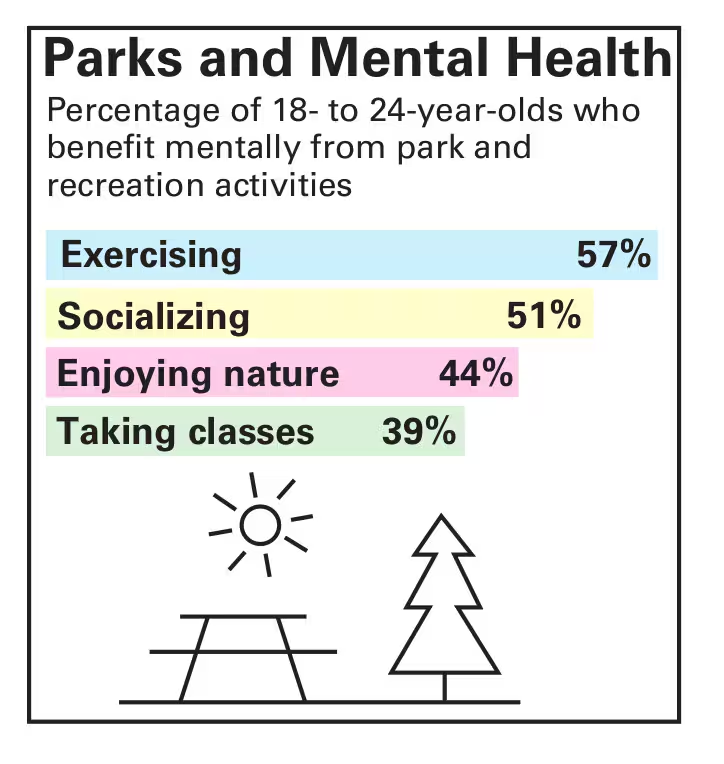
Parks and Mental Health In Exercises 13–18, use the figure, which shows the percentages from a survey of two hundred 18- to 24-year-olds in the United States who say that various park and recreation activities have a positive impact on their mental health. (Adapted from National Recreation and Park Association)


Bar graph showing percentages of 18- to 24-year-olds benefiting mentally from park activities: Exercising 57%, Socializing 51%, Enjoying nature 44%, Taking classes 39%.


Exercising and Taking Classes At α=0.01, can you reject the claim that the proportion of 18- to 24-year-olds who benefit mentally from exercising in parks is greater than or equal to the proportion who benefit mentally from taking classes in parks?

Verified step by step guidance
1
Step 1: Define the null hypothesis (H₀) and the alternative hypothesis (H₁). The null hypothesis is H₀: p₁ ≥ p₂, where p₁ is the proportion of 18- to 24-year-olds who benefit mentally from exercising in parks, and p₂ is the proportion who benefit mentally from taking classes in parks. The alternative hypothesis is H₁: p₁ < p₂.
Step 2: Identify the significance level (α) and the sample proportions. The significance level is given as α = 0.01. From the bar graph, the sample proportions are p̂₁ = 57% = 0.57 for exercising and p̂₂ = 39% = 0.39 for taking classes.
Step 3: Calculate the test statistic. Use the formula for the z-test for proportions: z = (p̂₁ - p̂₂) / √[p̂(1 - p̂)(1/n₁ + 1/n₂)], where p̂ = (x₁ + x₂) / (n₁ + n₂) is the pooled proportion, and n₁ and n₂ are the sample sizes for the two groups. Here, n₁ = n₂ = 200.
Step 4: Determine the critical value for the z-test at α = 0.01 for a one-tailed test. Use a z-table to find the critical value corresponding to a left-tailed test at the 0.01 significance level.
Step 5: Compare the calculated z-test statistic to the critical value. If the test statistic is less than the critical value, reject the null hypothesis. Otherwise, fail to reject the null hypothesis. Interpret the result in the context of the problem.

Verified video answer for a similar problem:

This video solution was recommended by our tutors as helpful for the problem above.
Video duration:
4m
Was this helpful?

Key Concepts

Here are the essential concepts you must grasp in order to answer the question correctly.

Hypothesis Testing

Hypothesis testing is a statistical method used to make decisions about a population based on sample data. It involves formulating a null hypothesis (H0) and an alternative hypothesis (H1), then using sample data to determine whether to reject H0. In this context, the null hypothesis would state that the proportion of 18- to 24-year-olds benefiting from exercising is less than or equal to that from taking classes.
Recommended video:
Guided course
06:21
Step 1: Write Hypotheses

Significance Level (α)

The significance level, denoted as α, is the threshold for determining whether a result is statistically significant. In this case, α is set at 0.01, meaning there is a 1% risk of concluding that a difference exists when there is none. This low significance level indicates a strong requirement for evidence before rejecting the null hypothesis.
Recommended video:
03:33
Finding Binomial Probabilities Using TI-84 Example 1

Proportions and Comparisons

Proportions represent the fraction of a whole, often expressed as a percentage. In this scenario, we compare the proportions of two groups: those benefiting from exercising (57%) and those benefiting from taking classes (39%). Understanding how to compare these proportions is crucial for determining if the difference is statistically significant, which is the essence of the hypothesis test.
Recommended video:
Guided course
10:28
Difference in Proportions: Hypothesis Tests Example 1
Related Practice
Textbook Question

Testing the Difference Between Two Means, (a) identify the claim and state H0 and Ha , (b) find the critical value(s) and identify the rejection region(s), (c) find the standardized test statistic t, (d) decide whether to reject or fail to reject the null hypothesis, and (e) interpret the decision in the context of the original claim. Assume the samples are random and independent, and the populations are normally distributed.

Pet Food

A pet association claims that the mean annual costs of food for dogs and cats are the same. The results for samples of the two types of pets are shown at the left. At , α=0.10 can you reject the pet association’s claim? Assume the population variances are equal. (Adapted from American Pet Products Association)

70
views
Textbook Question

Testing a Difference Other Than Zero Sometimes a researcher is interested in testing a difference in means other than zero. In Exercises 27 and 28, you will test the difference between two means using a null hypothesis of Ho: μ1-μ2=k, Ho: μ1-μ2>=k or Ho: μ1-μ2<=k . The standardized test statistic is still

Architect Salaries Is the difference between the mean annual salaries of entry level architects in Denver, Colorado, and Lincoln, Nebraska, equal to \(9000? To decide, you select a random sample of entry level architects from each city. The results of each survey are shown in the figure. Assume the population standard deviations are σ1=\)6560 and σ2=\$6100 . At α=0.01 what should you conclude? (Adapted from Salary.com)

36
views
Textbook Question

In Exercises 3–6, determine whether a normal sampling distribution can be used. If it can be used, test the claim about the difference between two population proportions and at the level of significance . Assume the samples are random and independent.


Claim: p1≠p2, α=0.01


Sample statistics: x1=35, n1=70, and x2=36, n2=60

88
views
Textbook Question

Independent and Dependent Samples In Exercises 5–8, classify the two samples as independent or dependent and justify your answer.

Sample 1: The maximum bench press weights for 53 football players

Sample 2: The maximum bench press weights for the same 53 football players after completing a weight lifting program

75
views
Textbook Question

Constructing Confidence Intervals for μd To construct a confidence interval for μd , use the inequality below.

Construct the indicated confidence interval for μd . Assume the populations are normally distributed.

[APPLET] Drug Testing A sleep disorder specialist wants to test the effectiveness of a new drug that is reported to increase the number of hours of sleep patients get during the night. To do so, the specialist randomly selects 16 patients and records the number of hours of sleep each gets with and without the new drug. The table shows the results of the two-night study. Construct a 90% confidence interval for μd.

103
views
Textbook Question

Test the claim about the difference between two population means and at the level of significance α. Assume the samples are random and independent, and the populations are normally distributed.

Claim: μ1=μ2, α=0.01, Assume (σ1)^2=(σ2)^2

Sample statistics:

x̅1=33.7, s1=3.5 , n1=12 and x̅2=35.5 , s2=2.2 , n2=17

118
views