Ch. 10 - Correlation and Regression
Triola - Elementary Statistics 14th Edition
Triola14th EditionElementary StatisticsISBN: 9780137366446Not the one you use?Change textbook
Chapter 10, Problem 10.1.3a

Notation The author conducted an experiment in which the height of each student was measured in centimeters and those heights were matched with the same students’ scores on the first statistics test.
a. For this sample of paired data, what does r represent, and what does represent?

Verified step by step guidance
1
Step 1: Understand the context of the problem. The author conducted an experiment measuring two variables: the height of students and their scores on a statistics test. These are paired data, meaning each student's height is matched with their test score.
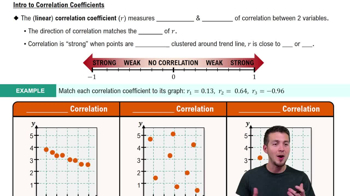
Step 2: Recognize that 'r' in this context refers to the correlation coefficient. The correlation coefficient is a statistical measure that describes the strength and direction of a linear relationship between two variables.
Step 3: The correlation coefficient 'r' ranges from -1 to 1. An 'r' value close to 1 indicates a strong positive linear relationship, meaning as one variable increases, the other tends to increase. An 'r' value close to -1 indicates a strong negative linear relationship, meaning as one variable increases, the other tends to decrease. An 'r' value around 0 suggests no linear relationship.
Step 4: The symbol 'ρ' (rho) often represents the population correlation coefficient, which is the correlation coefficient for the entire population. In contrast, 'r' is used for the sample correlation coefficient, calculated from sample data.
Step 5: To calculate 'r', you would use the formula: ((xi-x)(yi-y)(xi-x)^2(yi-y)^2), where x and y are the sample means of the variables.

Verified video answer for a similar problem:

This video solution was recommended by our tutors as helpful for the problem above.
Video duration:
4m
Was this helpful?

Key Concepts

Here are the essential concepts you must grasp in order to answer the question correctly.

Correlation Coefficient (r)

The correlation coefficient, denoted as 'r', measures the strength and direction of a linear relationship between two variables. In this context, 'r' quantifies how well the students' heights are related to their scores on the statistics test. A value of 'r' close to 1 or -1 indicates a strong linear relationship, while a value near 0 suggests a weak or no linear relationship.
Recommended video:
Guided course
05:43
Correlation Coefficient

Paired Data

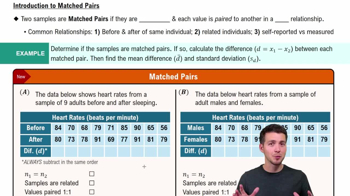
Paired data refers to sets of observations where each data point in one set is matched with a corresponding data point in another set. In this experiment, each student's height is paired with their test score, allowing for analysis of the relationship between these two variables. This pairing is crucial for calculating the correlation coefficient and understanding the association between the variables.
Recommended video:
Guided course
08:33
Introduction to Matched Pairs

Statistical Significance

Statistical significance assesses whether the observed relationship between variables is likely due to chance or represents a true association. When analyzing the correlation coefficient 'r', determining its significance helps to understand if the relationship between students' heights and test scores is meaningful. This involves hypothesis testing and considering the p-value to decide if the correlation is statistically significant.
Recommended video:
Guided course
05:53
Parameters vs. Statistics
Related Practice
Textbook Question

Effects of an Outlier Refer to the Minitab-generated scatterplot given in Exercise 9 of Section 10-1


a. Using the pairs of values for all 10 points, find the equation of the regression line.

192
views
Textbook Question

Explore!

Exercises 11 and 12 provide two data sets from “Graphs in Statistical Analysis,” by F. J. Anscombe, the American Statistician, Vol. 27. For each exercise,


a. Construct a scatterplot.

155
views
Textbook Question

Notation Using the weights (lb) and highway fuel consumption amounts (mi/gal) of the 48 cars listed in Data Set 35 “Car Data” of Appendix B, we get this regression equation:

y^ = 58.9 - 0.00749x, where x represents weight.

a. What does the symbol y^ represent?

149
views
Textbook Question

Time and Motion In a physics experiment at Doane College, a soccer ball was thrown upward from the bed of a moving truck. The table below lists the time (sec) that has lapsed from the throw and the corresponding height (m) of the soccer ball.

[IMAGE]

c. What horrible mistake would be easy to make if the analysis is conducted without a scatterplot?

166
views
Textbook Question

Least-Squares Property According to the least-squares property, the regression line minimizes the sum of the squares of the residuals. Refer to the jackpot/tickets data in Table 10-1 and use the regression equation y^ = -10.9 + 0.174x that was found in Examples 1 and 2 of this section.

a. Identify the nine residuals.

226
views
Textbook Question

Time and Motion In a physics experiment at Doane College, a soccer ball was thrown upward from the bed of a moving truck. The table below lists the time (sec) that has lapsed from the throw and the corresponding height (m) of the soccer ball.

[IMAGE]

b. Based on the result from part (a), what do you conclude about a linear correlation between time and height?

153
views