
Ch. 10 - Correlation and Regression
Triola - Elementary Statistics 14th Edition
Triola14th EditionElementary StatisticsISBN: 9780137366446Not the one you use?Change textbook
Chapter 10, Problem 10.RE.3b

Time and Motion In a physics experiment at Doane College, a soccer ball was thrown upward from the bed of a moving truck. The table below lists the time (sec) that has lapsed from the throw and the corresponding height (m) of the soccer ball.
[IMAGE]
b. Based on the result from part (a), what do you conclude about a linear correlation between time and height?

Verified step by step guidance
1
Step 1: Understand the problem. The goal is to determine whether there is a linear correlation between time and height based on the data provided. Linear correlation measures the strength and direction of a linear relationship between two variables.
Step 2: Review the data. Examine the table of time (independent variable) and height (dependent variable). Ensure the data is complete and ready for analysis.
Step 3: Calculate the correlation coefficient (r). Use the formula for Pearson's correlation coefficient: r=(x-x¯)(y-y¯)(x-x¯)2(y-y¯)2, where x and y are the variables, and x̄ and ȳ are their respective means.
Step 4: Interpret the correlation coefficient. If r is close to 1 or -1, there is a strong linear correlation. If r is close to 0, there is little to no linear correlation. Positive r indicates a positive relationship, while negative r indicates a negative relationship.
Step 5: Draw a conclusion. Based on the calculated r value, determine whether the data supports a linear correlation between time and height. Consider the context of the experiment and whether the relationship aligns with expectations from physics (e.g., parabolic motion).

Verified video answer for a similar problem:

This video solution was recommended by our tutors as helpful for the problem above.
Video duration:
3m
Was this helpful?

Key Concepts

Here are the essential concepts you must grasp in order to answer the question correctly.

Linear Correlation

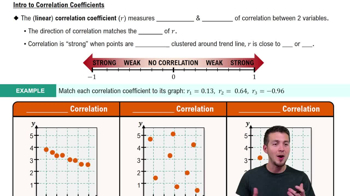
Linear correlation refers to the relationship between two variables where a change in one variable is associated with a proportional change in another. This relationship can be quantified using the correlation coefficient, which ranges from -1 to 1. A value close to 1 indicates a strong positive correlation, while a value close to -1 indicates a strong negative correlation. A value around 0 suggests no linear correlation.
Recommended video:
Guided course
05:43
Correlation Coefficient

Scatter Plot

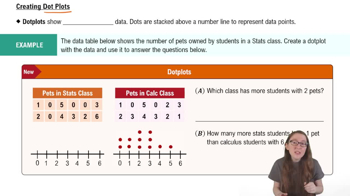
A scatter plot is a graphical representation of two variables, where each point represents an observation in the dataset. It helps visualize the relationship between the variables, making it easier to identify patterns, trends, or correlations. In the context of the soccer ball experiment, plotting time against height can reveal whether a linear relationship exists between these two variables.
Recommended video:
04:01
Creating Dotplots

Regression Analysis

Regression analysis is a statistical method used to determine the relationship between a dependent variable and one or more independent variables. In this case, it can help quantify how height (dependent variable) changes with time (independent variable). By fitting a regression line to the data, one can assess the strength and nature of the correlation, providing insights into the dynamics of the soccer ball's motion.
Related Practice
Textbook Question

Time and Motion In a physics experiment at Doane College, a soccer ball was thrown upward from the bed of a moving truck. The table below lists the time (sec) that has lapsed from the throw and the corresponding height (m) of the soccer ball.

[IMAGE]

a. Find the value of the linear correlation coefficient r.

177
views
Textbook Question

Effects of an Outlier Refer to the Minitab-generated scatterplot given in Exercise 9 of Section 10-1


a. Using the pairs of values for all 10 points, find the equation of the regression line.

192
views
Textbook Question

Time and Motion In a physics experiment at Doane College, a soccer ball was thrown upward from the bed of a moving truck. The table below lists the time (sec) that has lapsed from the throw and the corresponding height (m) of the soccer ball.

[IMAGE]

c. What horrible mistake would be easy to make if the analysis is conducted without a scatterplot?

166
views
Textbook Question

Least-Squares Property According to the least-squares property, the regression line minimizes the sum of the squares of the residuals. Refer to the jackpot/tickets data in Table 10-1 and use the regression equation y^ = -10.9 + 0.174x that was found in Examples 1 and 2 of this section.

a. Identify the nine residuals.

226
views
Textbook Question

Casino Size and Revenue Use the same paired data from the preceding exercise.

b. What is the best predicted amount of revenue for a casino with a size of 200 thousand square feet? Is it likely that the best predicted amount of revenue will be accurate?


101
views
Textbook Question

Notation The author conducted an experiment in which the height of each student was measured in centimeters and those heights were matched with the same students’ scores on the first statistics test.

a. For this sample of paired data, what does r represent, and what does represent?

283
views